Robin Hood Spotlight

A Little Gest of Robin Hood
by Bob Frank

Spotlight Review by Allen W. Wright
(Late 2001, Fully Expanded January 2026)

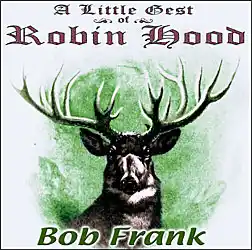
CD cover of A Little Gest of Robin Hood by Bob Frank, art by Ernest Thompson Seton

Introduction

At the 2001 Robin Hood conference, I was delighted to meet singer/songwriter Bob Frank and get to experience live his transformation of the early Robin Hood ballad A Gest of Robyn Hode.

When Bob released his version of the Gest on CD, I gladly wrote up a blurb praising what I thought then -- and still think now --is an absolutely wonderful addition to the Robin Hood canon.

Apparently at the time I was hoping to sell an article about Bob and his Gest. That never came to pass. So I am greatly expanding this page to give his work full due.

The original text of this page appears at the bottom.

Bob Frank passed away on July 18, 2019. He is sorely missed.

Background

Robert Landis Frank was born and raised in Memphis, Tennessee. After serving in Vietnam, he moved to Nashville and then to California. Vanguard Records released his self-titled album Bob Frank in 1972. He had a contentious relationship with the record company, not playing songs from the album during his live performances, but new songs. While no more records were produced for decades, Bob became a legend on the folk scene. And that early album became a cult classic.

In the early 1970s, Bob was reading Francis Child's collection of ballads searching for new material and he happened upon A Gest of Robyn Hode, ballad number 117 in Child's multi-volume collection of English and Scottish popular ballads. As he wrote on his website,

It was like I was picking up artifacts from an archeological dig, dusting them off, and revealing something amazing that had been hidden for centuries. As I got deeper and deeper into this obscure beauty, I became entranced by it. This stuff was pure gold.

-- Bob Frank on bobfranksongs.com

He translated -- or glossed -- the ballad, updating it so modern audiences could find it as fresh and exciting as he did. And then, Bob stuck this translation (or gloss) into a drawer, only bringing it out to play for friends or family.

And then in 2000, he discovered Thomas Ohlgren's Medieval Outlaws: Ten Tales in Translation (12 tales in the revised edition). There was the Gest in modern English. Bob Frank reached out to Thomas Ohlgren, and Tom published Bob Frank's original translation on the website of Purdue University. Tom also introduced Bob to the wider world of Robin Hood scholarship and the then-upcoming 2001 Robin Hood academic conference in London, Ontario, Canada. Bob was invited to attend and play his music.

I met and talked with Bob quite a bit at the conference. And I well-remember when he performed the first two fits of his Gest for us. It was electrifying. There's been much debate about how the early Robin Hood ballads were performed. They weren't songs like some of the later ballads were. Were they just recited? Well, as Bob played, top scholars Stephen Knight and Douglas Gray conferred and agreed what Bob was doing is exactly how the Gest would have been performed. Not exactly sung, but Bob's words fit the music. It was a performance -- and very alive. At the time, he'd only developed music for the early sections of the Gest.

We wanted more, and we got more. By Christmas time, many of us received copies of the newly recorded and expanded version of the Gest. And once again, the Robin Hood scholars were elated. You can find the praise of myself and others on this page of Bob's website.

Updating the Language

Bob Frank didn't just translate (or gloss) a few medieval words into modern English. He updated the tone in many places to be more conversational. And when a modern word affected the rhyme of the original, he updated the rhyme -- often improving the original with a phrase that's even more clever.

Here are just a few examples.

Lythe and listin, gentilmen,
That be of frebore blode;
I shall you tel of a gode yeman,
His name was Robyn Hode.

-- Medieval version of the Gest

Attend and listen, gentlemen, who are of freeborn blood, I shall tell you about a good yeoman whose name was Robin Hood.

— Thomas H. Ohlgren's translation from Medieval Outlaws

Stop and listen, everybody,
This story's pretty good.
It's all about a bold outlaw,
His name was Robin Hood

.-- Bob Frank's original adaptation, available on Thomas H. Ohlgren's website

Hey, everybody! Check this out.
This story's pretty good.
It's all about a bold outlaw,
His name was Robin Hood

— Recorded version by Bob Frank

The version posted on Tom Ohlgren's website -- which I believe represents what Bob sent him before the 2001 conference and subsequent CD release -- is different than the final version. The CD version is friendlier with a "hey, everybody" instead of "stop". And "check this out" instead of listen. It conveys the intent of the original but in a way far more engaging for modern audiences.

The original call to "men of freeborn blood" is antiquated and has some unpleasant connotations in an American context. So, the substitution for "this story's pretty good" is a smart one, even if the meaning isn't quite the same. It also keeps the rhyme better in modern English than the original rhyming blood with hood.

However, the use of "good" meant the original's "good yeoman" in the opening stanza would be repetitive of the word good -- although he retains the phrase when it is used elsewhere. Instead Bob substitutes the phrase "bold outlaw" that can be found in ballads such as Robin Hood and Allen a Dale and Robin Hood's Delight -- and is also included in the title of the very website that hosts this article.

Here's another example of one of his alterations.

"Take thy gode bowe in thy honde," sayde Robyn;
"Late Much wende with the:
And so shal Willyam Scarlok,
And no man abyde with me.

"And walke up to the Saylis,
And so to Watlinge Strete,
And wayte after some unkuth gest,
Up chaunce ye may them mete.

"Be he erle, or ani baron,
Abbot, or ani knyght,
Bringhe hym to lodge to me;
His dyner shall be dight."

-- Medieval version of the Gest

Robin replied, “Take your good bow in your hand, and let Much the Miller’s son and William Scarlock go with you, and no man stay with me. Walk up to the Saylis and to Watling Street and look for some unknown guest. If he is an earl, baron, abbot, or knight, bring him to stay with me—his dinner will be waiting for him.”

— Thomas H. Ohlgren's translation in Medieval Outlaws

Take thy good bow in thy hand," said Robin.
"Let Much go with thee.
And also William Scarlett,
And no man stay with me.

"And walk up to the Saylis
And down to Watling Street,
And wait for some unknown guest
That you may chance to meet.

"And be he earl or baron,
Abbot or knight or squire,
Bring him to me at the greenwood tree.
His dinner shall be on the fire."

-- Recorded version by Bob Frank

The original rhymes knight with dight -- a word meaning ready. Since ready (or waiting for him, as Ohlgren translates it) wouldn't rhyme with knight. Bob Frank switches up the rhyme by inserting the word squire to rhyme with the fun and more evocative "His dinner shall be on the fire."

The influence of Tom Ohlgren's guidance can be seen when comparing Bob's original translation of the Gest with the one on the CD. For example, when Little John suggests giving the knight some clothes, he says that Robin has "scarlet and grene" clothing in all the surviving medieval texts. But the footnotes to Stephen Knight and Thomas Ohlgren's edition of the Gest suggest that this was likely a corruption from "scarlet in grain". Ohlgren's prose translation furthers this idea with describing the clothes as "fast-dyed scarlet". The original text of Bob's translation is ""For you have scarlet and green, master," but the CD version is "For you have scarlet dyed deep in the grain".

The language of Bob's translation is relatively clean, with only a couple of mild profanities. One comes in the third fit, when Little John is serving the sheriff and comes into conflict with the cook. Again, it's updating language that's a touch archaic and a rhyme that would not work in translation.

"I make myn avowe to God," saide the coke,
"Thou arte a shrewde hynde
In ani hous for to dwel,
For to aske thus to dyne."

-- Medieval version of the Gest

“By God,” said the cook, “to ask like this to dine, you are a cursed servant to dwell in anyone’s house.”

— Thomas H. Ohlgren's translation in Medieval Outlaws

"I make my vow to God," said the cook,
"You aren't worth a piss
To live in any house
And eat like this."

-- Recorded version of Bob Frank's Gest

The only other mild profanity I hear is when the king is lamenting the absence of deer with any good horns (because Robin Hood has poached them all.) The medieval Gest rhymes one with horn. Bob changes uses the word "hart" for a male deer and rhymes it with "Whose horns were worth a fart." 

Bob Frank's skill as a songwriter and his rich sense of humour ensures the story was brought to life while retaining the essence of the original text. I've seen no other updating of the Gest that handle this difficult task even a tenth as well.

The Music

The Gest is not a song in the modern sense. It is a story in verse. The star of Bob's version of the Gest, and undoubtedly so in the late 15th century version too, is the person telling the story. Bob isn't quite singing. It's definitely telling a tale, and the story never gets lost. But his voice also fits the music.

Mostly the music has a sort of strolling tune -- like you might hear at a camp fire. But he does vary the tone a bit. When speaking of the villains, the music gets harsher -- to represent the mood. Also, the music of the sixth fit is much faster than elsewhere, as the tale switches into action mode.

The music keeps the story moving, but never at the expense of the words themselves.

The Legacy of Bob Frank's Gest

Certainly when we first heard it back in 2001, Bob's version of the Gest caused many of us to rethink the nature of the early tales. I'd certainly hope that legacy continues. The lesson it teaches us is all that you need to bring the medieval tales to life is an artistic genius. Sadly, there aren't many of those about and Bob was a true original who would be hard to replace.

From what people in the folk music industry have said, it was a shock to see Bob Frank's name reappear after so many years in the recording wilderness. He'd become an anti-authoritarian legend -- just like a certain medieval outlaw I've heard tell of. 

Since the Gest was released on his own label Bowstring Records, Bob went on to release a dozen more albums. Some through Bowstring, and some through other labels.

In 2019, a feature length documentary about Bob Frank was released called Within A Few Degrees: A Little Gest of Bob Frank.

Original Article (circa late 2001 / early 2002)

If you've spent any time on my website, you have probably seen me mention A Gest of Robyn Hode. This 15th century ballad isn't only one of the earliest tales of Robin Hood, it's also the longest and most influential of the Robin Hood ballads. The Errol Flynn and Kevin Costner movies? The Richard Greene, Michael Praed and Jason Connery TV shows? The books of Howard Pyle and Robin McKinley? They've all borrowed plot elements from the Gest.

Cover art to the CD by Ernest Thompson SetonI re-read the ballad in its original late middle English (post-Chaucer, pre-Shakespeare) at least twice a year. And yet, listening to the new CD recording by California folk singer/songwriter Bob Frank, I fell in love with the ballad again in a brand new way.

Most times you hear great works of literature, they are delivered in a dry, flat tone. Not this version. Bob's Gest reminds us that these stories were meant to entertain. His translated lyrics and vocal performance (which isn't quite singing, but sort of is singing) bring the classic tale alive. Accompanying the piece with guitar music, Bob's Gest sounds thoroughly American, but also totally faithful to the spirit of the original.

It's fresh, funny and I give it my highest recommendation. It's nearly an hour and 20 minutes long, and yet stays lively throughout. The only reason I don't say more about it is because ... well, I'm trying to get a paying gig about writing an article about Bob's Gest, and I don't want to compete with myself.

You can order A Little Gest of Robin Hood online, and learn a lot more about it at Bob's website www.bobfranksongs.com .

And please tell him that Allen sent you.

CD Cover illustration by Ernest Thompson Seton
Where to find Bob Frank's A Little Gest of Robin Hood

You used to be able to purchase the Gest on Bob's website. The links no longer work -- understandable since his passing. But you can find it digitally on all the major platforms --iTunes, Apple Music, Amazon Music and Spotify.

If there's a particularly way to purchase it that most helps his family, I'd love to know.

Where to go from here:

If you enjoyed this Spotlight, check out the following:

Contact Us

© Text and Location pictures, Copyright 2026 Allen W. Wright - All Rights Reserved
Other pictures and quoted text are copyright their respective owners and used under fair use for the purpose of criticism and review.

This page is a part of Robin Hood -- Bold Outlaw of Barnsdale and Sherwood