The previous section explored the development of the Robin Hood legend in 19th and 20th century children's literature and also on stage with productions such as Reginald De Koven's Robin Hood: A Comic Opera. This section looks at new mediums -- movies and television. We also look at Robin Hood in works of science fiction and fantasy. In the 20th and 21st century, movies and TV shows are dominant ways we experience the legend.
Robin Hood first became a movie star in 1908 with two short films, an American one-reel short called Robin Hood (from the Kalem production company) and a British short Robin Hood and His Merry Men (from the Clarendon company). And by 1914, there were several Robin Hood films, and that's not counting his appearances as Locksley in adaptations of Ivanhoe.
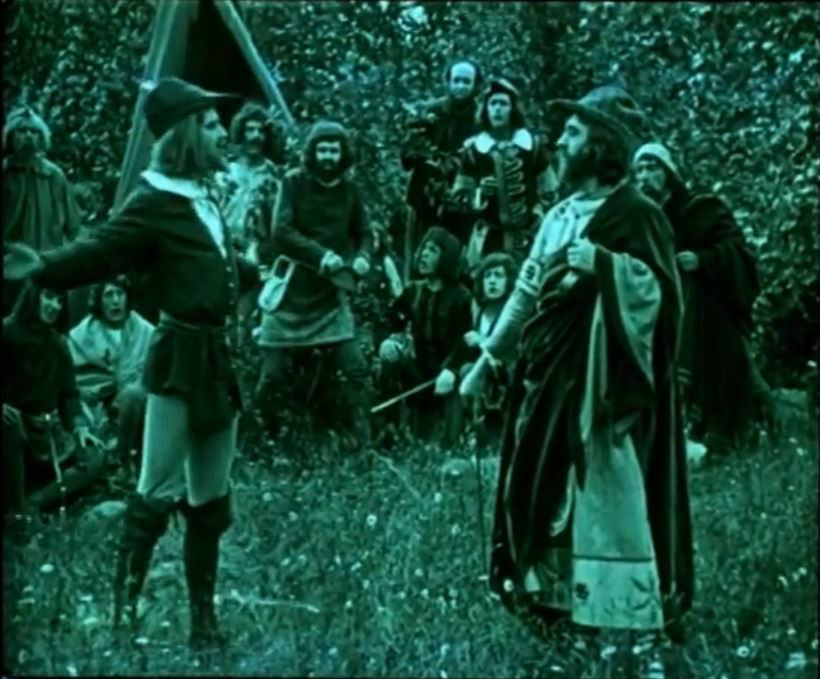
While many of these are lost, the 1912 Robin Hood from Eclair still exists, lovingly restored in the 21st century. It stars Robert Frazer as Robin Hood and Barbara Tennant as Maid Marian. This film has Sir Guy of Gisbourne as a rival for Marian's affections, an element from the Reginald De Koven's comic opera that was worked into many film versions. The movie also incorporated elements from the ballad Robin Hood and the Butcher. The same year saw the release of Robin Hood - Outlawed.
And not all the silent films were in black-and-white. The three-reel 1913 Robin Hood by Kinemacolor was in colour, with the review in Variety praising "the royal purple robes of office, to say naught of the trend of the yeoman and their women folk toward vivacious color effects and the picturesque and dashing bottle green costumes of the vagrant band". The review proclaims "by reason of its chromatic qualities the color filmed version of the story must supersede any rival black-and-white film covering the same subject." The film featured Will Scarlet's wooing of Christabel, who was Alan a Dale's love interest in Pierce Egan's 19th century novel Robin Hood and Little John As mentioned in the previous section, the French translation / adaptation was credited to Alexandre Dumas, and it would go onto inspire other Robin Hood films and TV shows.. The Sheriff's name in the film is Baron Fitz Alvine, a variation of the name of Egan and Dumas's villain. (Will's romantic partner in Egan's novel was Maude, but romantic entanglements formed a popular element in these early films, as another Robin Hood film from 1913 includes Ellen, Allan-a-Dale's wife from Howard Pyle's novel among its characters.)
The "Robin Hood hat" -- the medieval hunting cap known as a bycocket -- became a common element of the legend in stage depictions. For decades, Robin Hood wore the bycocket in movies, and it became an instantly recognizable symbol for the outlaw.
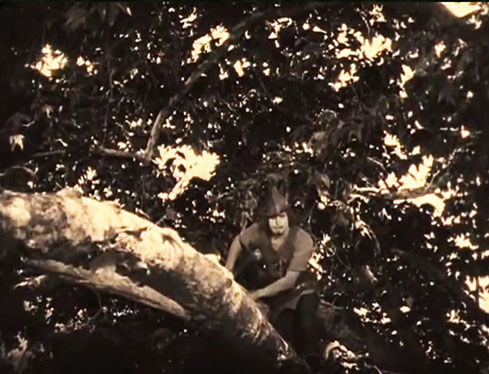
In 1922, Douglas Fairbanks, Sr. starred as Robin Hood in a full-length silent film classic. The 1922 Robin Hood (or more correctly Douglas Fairbanks in Robin Hood, as the actor's name was included in the official title) was the most expensive movie made at the time.
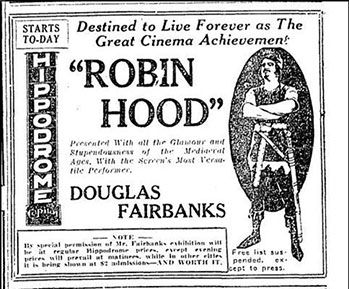
It had lavish castle sets and jousting sequences, and Fairbanks was a fondly-remembered swashbuckling outlaw. The film was directed by the Toronto-born Allan Dwan, and the script was credited to Elton Thomas (whose real name was Douglas Elton Thomas Ullman, although much better known as Douglas Fairbanks).
The movie begins with Fairbanks as the Earl of Huntingdon who is "afeared of women" until he meets Marian Fitzwalter, played by Enid Bennett. Huntingdon goes on crusade with King Richard, but Marian sends a letter with his squire Little John (played by Alan Hale) urging him to return to England and stop Prince John's tyrannies. The movie is more than half over by the time this title card is flashed.
Thus it was that Huntingdon buried his Yesterday. Here began a new life -- a life to be dedicated to revenge -- bitter -- but joyous.
Robin Hood's heroic deeds are shown in brief montage. Norman Reilly Raine, one of the writers of the later, and better-remembered Robin Hood films cautioned against following the Fairbanks example.
The Fairbanks picture, in order to live up to its tournament fade-in, had to ring in the whole goddamned Crusades; and a light taste of the real Robin Hood story was dragged in as a tag at the end to justify the use of the name.
- Quoted in Rudy Behlmer's "Introduction: From Legend to Film"
THE classic Robin Hood is Errol Flynn in Warner Bros., 1938 The Adventures of Robin Hood. Yes. Robin and his Merry Men wear tights. Parts are anachronistic and unhistorical (there's a car in one shot). But it's also fun -- lots of fun.
Errol Flynn is extremely charismatic as the roguish Saxon freedom fighter. There are a lot of witty exchanges such as when Marian expresses shock at Robin's insults of Prince John. "Why, you speak treason." "Fluently," Robin replies.
He's not a completely light-hearted Robin though as he tells Prince John "I'll organize revolt. Exact a death for a death." With just enough of the edge to keep his Robin from seeming defanged or irrelevant. Flynn gets the tone exactly right.
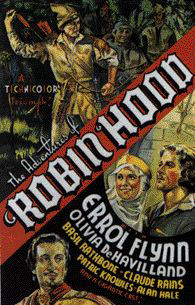
Like in the Fairbanks picture, the Sheriff doesn't have much to do in this film. He's a comic foil for the main villains. Guy of Gisbourne, played with debonair villainy by Basil Rathbone, is a nasty Norman knight. He's also a suitor for Maid Marian, played with charm by Olivia de Havilland -- an idea taken from the 1890 de Koven musical. And Claude Rains plays a devilishly witty and wily Prince John.
Also worthy of mention is Una O'Connor as Marian's older companion Bess. She has a fledging relationship with Herbert Mundin's Much.
The Adventures of Robin Hood has many scenes from the Robin Hood ballads,. These include the quarterstaff duel between Robin and Little John (played by Alan Hale, Sr. reprising his role from the 1922 film and who would be Little John again in the 1950 Rogues of Sherwood Forest), Eugene Pallette's Friar Tuck carrying Robin Hood on his back, the archery tournament from the 15th century ballad A Gest of Robyn Hode (and the later Robin Hood and the Golden Arrow) with the arrow-splitting from Ivanhoe added in, and the pardon from the king.
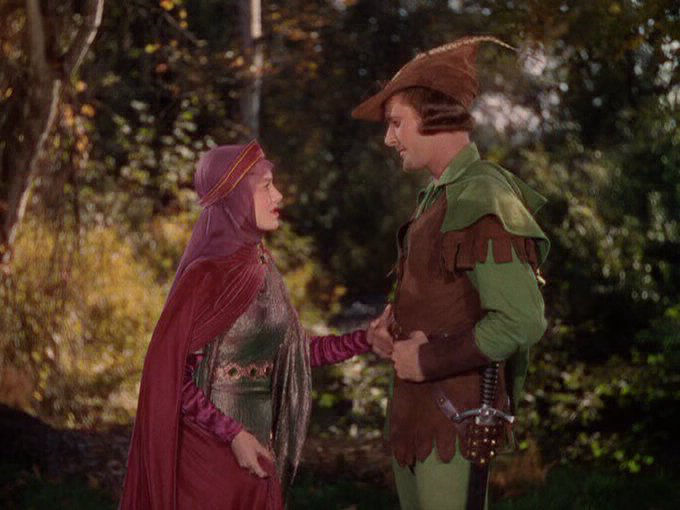
The 1938 film plays up the coflict between Normans and Saxons that was introduced in Sir Walter Scott's novel Ivanhoe, but as Robin remarks to Marian "Norman or saxon -- what's that matter? It's injustice I hate, not the Normans."
The film has two directors -- William Keighley, who directed mainly of the outdoor sequences, and Michael Curtiz, Curtiz was responsible for the indoor sequences and also reshot some of the earlier footage. Curtiz, and his director of photography Sol Polito, provided some stunning images. For example, the final swordfight between Errol Flynn and Basil Rathbone has been copied, homaged and parodied many times.
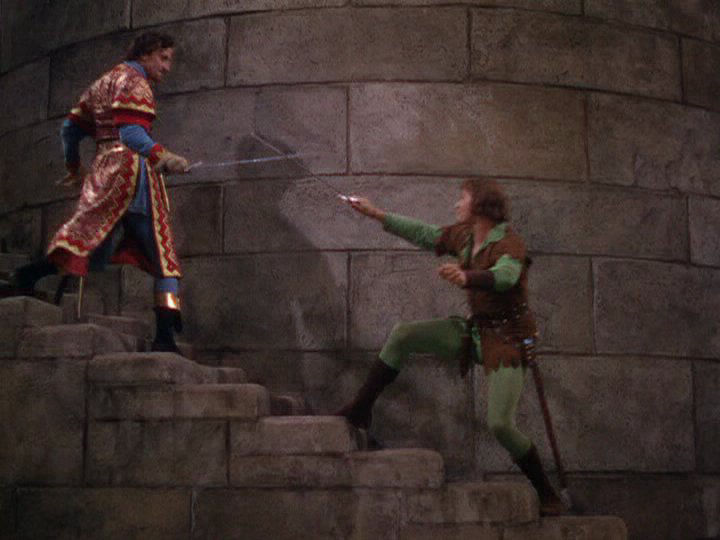
The film also has some of the best music in cinematic history, as the film's score by Erich Wolfgang Korngold won the Oscar for that year. For all the overall package, it's hard to compete with the 1938 movie.
Flynn's take on the character was so successful than some Robin Hood films didn't want to compete with his Robin. So, there are some movies starring the son of Robin Hood.
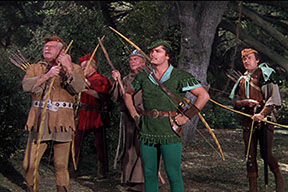
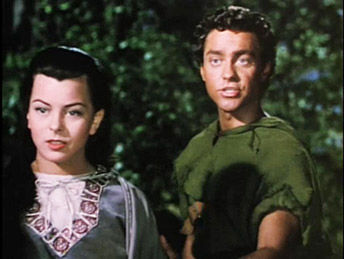
Cornel Wilde was the young Robert of Nottingham in 1946's The Bandit of Sherwood Forest and John Derek played another of Robin's offspring in the 1950 Rogues of Sherwood Forest. Oddly, the 1958 movie actually called The Son of Robin Hood really features Robin's daughter, Deering. Another daughter of Robin Hood, Gwyn played by Keira Knightley, starred as the Princess of Thieves in the 2001 TV movie.
However, some post-Flynn films did feature Robin, rather than his offspring. Jon Hall as Robin in the 1948 version of Prince of Thieves (after the Dumas novel, and one of the few films featuring the Alan-a-Dale love story.) The forgettable Tales of Robin Hood starring Robert Clarke made it to the big screen in 1951, only after failing as a TV pilot.
Richard Todd played a fine, though not quite as swashbuckling, Robin in Disney's 1952 live-action movie The Story of Robin Hood and his Merrie Men. Joan Rice's Marian has a lot of spirit and is more involved in the action that many screen Marians. She has a trickster's charm that might even exceed her Robin's. It might not be as classic as Errol Flynn, but this is a good take on the legend with fine direction by Ken Annakin.
Like the Flynn film, many classic moments from the ballads are recreated including the first meetings with Little John and Friar Tuck, Marian's page-boy disguise, and Robin rescuing poachers from the hangman. Elton Hayes as the minstrel Alan-a-Dale guides viewers through the story.
The next time Disney made a Robin Hood movie, in 1973 Alan-a-Dale still serves as narrator. But this time, he's a rooster and Robin is a cartoon fox. (There's more on this movie later.)The Disney cartoon is the best known animated version of the legend, but Robin's had a long history in animation.
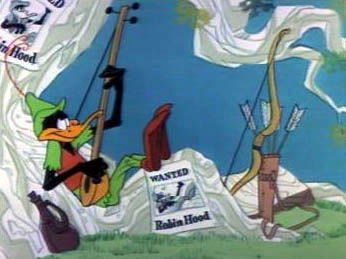
All from Warner Bros., Squirrels reenacted the legend in "Robin Hood Makes Good" (1939); Daffy Duck has assumed his identity ("Robin Hood Daffy", 1958), and Bugs Bunny met the Errol Flynn Robin Hood ("Rabbit Hood", 1949).
The 1960s Canadian cartoon Rocket Robin Hood featured a futuristic version of the hero, and the 1991, also Canadian, Young Robin Hood featured the inconsequential adventures of youthful versions of the outlaws. Younger versions of the outlaws were also featured in the 1990-1992 Japanese anime TV series Robin Hood no Daiboken (Robin Hood's Great Adventure). Robin is also a teenager in the 21st century cartoon series Robin Hood: Mischief in Sherwood, an international production.
Hammer Studios produced three Robin Hood movies in the 1950s and 1960s. The first was 1954's Men of Sherwood Forest - one of the weakest entries in the outlaw's cinematic canon.
Next in 1960, The Sword of Sherwood Forest, was a follow-up to the TV series starring Richard Greene. Greene was the only actor to reprise his role from the series. The sheriff was played by Peter Cushing. The movie featured Robin foiling a plot to assassinate Hubert Walter, who was both the Archbishop of Canterbury and the Chancellor.
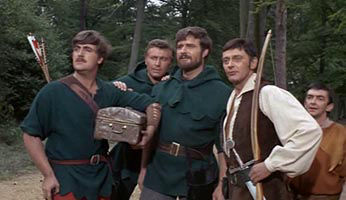
The third Hammer Robin Hood film was 1967's A Challenge for Robin Hood starring Barrie Ingham as Robin de Courtenay, a knight in a battle for his inheritance. Ingham's Robin Hood is a bit bland and untraditional.
However, the movie did recycle a few actors from previous versions. James Hayter reprises his role as Tuck from the 1952 The Story of Robin Hood and John Arnatt who played the deputy sheriff from the final season of the Richard Greene TV series plays the Sheriff of Nottingham in this movie.
In 1969, they tried to make a Robin Hood TV series starring David Warbeck. It was not picked up, and Hammer released the pilot episodes theatrically in 1973 as Wolfshead. [The movie was once available on US video under the title of "The Legend of Young Robin Hood".]
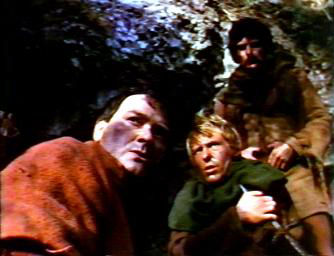
It's set in Barnsdale "Forest" and doesn't feature a Sheriff of Nottingham. However, the bad guys from the early ballad A Gest of Robyn Hode, the Abbot of St. Mary's and Sir Roger of Doncaster are on hand to cause trouble. This film has a historical look and feel to it that would be the standard in the next era of Robin Hood movies. [David Butler, the film's writer, was a friend of Richard Carpenter, the creator of the 1980s Robin of Sherwood TV series.]
But unlike the later gritty-looking Robin Hood movies and TV series, Wolfshead has almost no humour and it suffers greatly for it. It seems the legend can't be unrelentingly serious.
The next Robin Hood film lacked grit, but it didn't lack for humour. In 1973 Disney released another Robin Hood film, this time a cartoon with the characters drawn as animals.
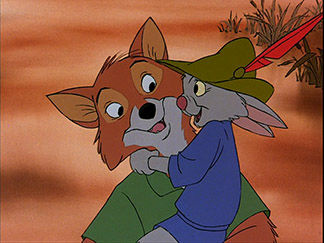
Robin Hood is a fox -- a holdover from Walt Disney's long-held idea of doing a cartoon based on the trickster Reynard. After Walt Disney passed away, writer / designer Ken Anderson suggested applying some of the Reynard concepts to Robin Hood.
The film was overseen by the surviving members of Disney's Nine Old Men, including director Wolfgang Reitherman and animators / character designers Ollie Johnston and Frank Thomas
The 1973 Robin Hood is not a crowing achievement in Disney animation. Much of the animation is adapted from previous cartoons. Little John is a big dumb bear played by Phil Harris and has more than a passing resemblance to his Baloo from the 1967 Jungle Book.
And yet it surely must be one of the influential versions of Robin Hood ever, delighting generations of children. Brian Bedford is utterly charming as Robin, and Peter Ustinov is delightful as a neurotic lion version of Prince John, or "PJ" as he's nicknamed in the movie.
The 1973 Disney animated movie is also remembered for its songs, Roger Miller (the voice of Alan-a-Dale, "minstrel -- that's an early day folk singer") wrote and sings Oo-de-lally, and Phil Harris sings "The Phony King of England" written by Johnny Mercer.
One of the best Robin Hood films is Robin and Marian from 1976, starring Sean Connery and Audrey Hepburn as the aging leads. Robin returns to England after a lifetime of fighting along side King Richard and tries to re-capture youthful glories one last time.
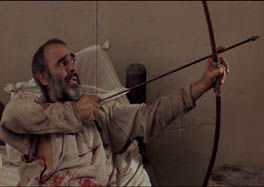
It's one of the few films to dramatize the death of Robin Hood. But oddly for a film that ends with Marian -- herself now the prioress of the ballads --poisoning herself and Robin,
The film was not successful at the box office. Possibly it's because it was marketed as a romantic film "Love is the greatest adventure", and audiences weren't expecting it to end in a murder-suicide.
It's an ending entirely in keeping with the the tone of 1970s cinema. This movie is both wistfully nostalgic for the past, but also debunks it.
And yet, despite its grim ending, Robin and Marian has humour and vitality that Wolfshead lacks. The clever script is by James Goldman, who also wrote the excellent stage play and film The Lion in Winter (about Henry II's highly-dysfunctional family).
Mind you, the film's real strength might be the strength of the movie's four central actors: Connery, Hepburn, Robert Shaw as the sheriff and Nicol Williamson as Little John. Director Richard Lester had a dream cast to work with.
Around 1990, there were at least four Robin Hood movies actively being developed. Only two were made in 1991.
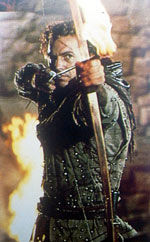
Robin Hood: Prince of Thieves starred Kevin Costner as a nice guy Robin with a wise black sidekick and a rebel-with-a-poorly-written-cause Will Scarlet. Morgan Freeman's quite good as the Moor, Azeem, and the British supporting characters are enjoyable. But with a clunker of a script, direction by Kevin Reynolds and miscast leads, there are more legitimate reasons to criticize this movie than Costner's lack of an English accent. [Oh, this wasn't the first film titled Prince of Thieves, there was a 1948 film with that based on Dumas's Robin Hood novel. The Costner film was unoriginal on many levels.]
And yet Alan Rickman's Sheriff of Nottingham is an evil delight. He invested the movie with such life that it's not surprising this movie became the second-highest grossing movie in North America that year. It was hit on the increasingly popular home video market too. For fans of a certain age, Costner's Robin Hood is their Robin Hood.
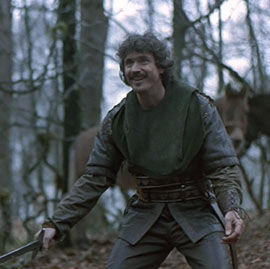
The second movie was only released on TV and video in America, in order to avoid competing with Costner. And that's a shame because Robin Hood starring Patrick Bergin and directed by John Irvin is a far better movie.
Bergin has roguish gleam, but can also play a very angry and dangerous -- almost crazed -- Robin. There are touches of the medieval Robin in this movie, which isn't too surprising since J.C. Holt, Robin Hood scholar, served as a consultant. Bergin seems most like the Robin of the early ballads, and Uma Thurman brings an independent sparkle to her Marian.
It's far from a perfect film. (If the villains were the strongest element of Costner's film, they are the weakest element of Bergin's.) But it deserves to be remembered more than it is.
The Costner film was popular enough that it was a key inspiration for Robin Hood: Men in Tights, -- director Mel Brooks's second comic take on the legend. (Check out the TV sections below for his earlier effort.) The characters Asneeze and Ahchoo are a wink to Morgan Freeman's Azeem and Roger Rees's Sheriff of Rottingham is decked out like Alan Rickman's sheriff. How much of the film sends up scenes from the 1938 film. Cary Elwes's Robin Hood costume seems to be cut from the same cloth as Errol Flynn's.
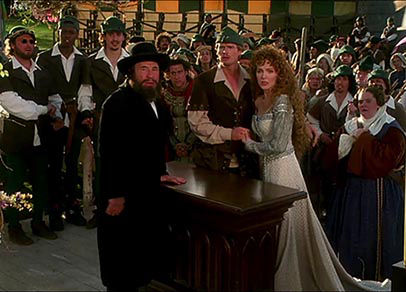
The subtitle Men in Tights sounds like a parody of Prince of Thieves, but it parodies an aspect of Robin Hood movie press releases. Robin Hood didn't wear tights in several movie versions since the 1970s. But the publicity material of the Costner film -- and the publicity material for Robin Hood TV shows and movies for decades to come would proudly declare their Robins are not wearing tights -- as if this were a new development.
The title song in "Men in Tights" hints why so many publicists took great pains to deny the tights.
We're men, we're men in tights
We roam around the forest looking the forest looking for fights
We're men, we're men in tights
We rob from the rich then give to the poor, that's right!
We may look like sissies
But watch what you say or else we'll put out your lights
We're men, we're men in tights
Always on guard defending the people's rights
Mel Brooks appears as a character in the film -- Rabbi Tuckman, a Jewish spin of Friar Tuck. And his character has a whiff of the gay panic that troubles modern Robin Hood productions.
Robin Hood : You are entering the territory of Robin Hood and his Merry Men.
Rabbi Tuckman : Faygeles?
[clears their throats, trying to act macho]
Robin Hood : No, no. We're straight. Just... merry.
Other movies also shied away from using the phrase "Merry Men". These jokes and the PR efforts that inspired them land a bit differently today than they did back then.
Fimmakers still dance with Robin Hood's reputation. They seek to capitalize on the character's name recognition, but also want to establish their Robin Hood as being different from what came before.
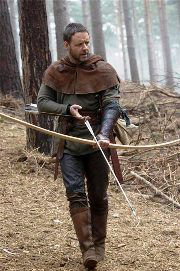
In 2010, Robin Hood returned to the big screen in a new film directed by Ridley Scott and starring Russell Crowe as "Robin Longstride". As with 1976's Robin and Marian, this film simply titled Robin Hood opened with King Richard's death in 1199. Robin was one of the king's soldiers who went on to impersonate the noble Robert of Loxley.
But it turns out that this commoner Robin Hood wasn't so common after all. Robin's father was a visionary stone mason who had drafted an early version of Magna Carta. Robin fights off a French invasion and helps introduce a major historical document. Perhaps the filmmakers' claims to grounded realism were a bit overstated. (The original idea for the film was to feature a heroic sheriff and a less-heroic Robin. You can read an interview with the original writer here.)
The following year realism was out of fashion. In 2011, the outlaw becomes an undead menace in 3D German film Robin Hood: Ghosts of Sherwood - later retitled Robin Hood: Dark Forest.
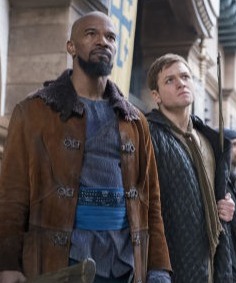
2018 saw two Robin Hood movies in competition again.
The 2018 film which made it to North American movie theatres is simply called Robin Hood again. It is directed by Otto Bathurst and stars Taron Egerton as Robin and Eve Hewson as Marian.
It seems to draw inspiration from the 2006-2009 Robin Hood TV series in imagining that the adventure takes place in a fantasy version of the past that mixes the modern with the medieval. Nottingham is re-imagined as an industrial hellscape -- "the bank and beating heart of our great church and its glorious crusade."
Audiences also noticed similarities with Christopher Nolan's Dark Knight movies. Jamie Dornan's smoldering socialist leader Will Scarlet is scarred and transformed into a villain, much like Batman's Two-Face.
It also takes from the recent TV and film tradition of a Muslim member of the Merry Men to re-fashion Little John as Yahya ibn Uma, played by Jamie Foxx.
Whereas Robin Hood Prince of Thieves was the second highest grossing North American film of 1991, the 2018 Robin Hood is regarded as one of the biggest box office flops of its year. The competing movie of 2018 -- Robin Hood: The Rebellion -- fared even worse. merely being released on home video and streaming services, not at the cinema.
A new film The Death of Robin Hood starring Hugh Jackman is due to be released in 2026. It promises to feature a far less heroic outlaw that we commonly see.
Robin Hood's also starred in non-English films such as the 1962 Italian film Il trionfo di Robin Hood (The Triumph of Robin Hood) and the 1975 Soviet film The Arrows of Robin Hood.
Robin -- or rather "Locksley" -- turns up in the various film and television adaptations of Ivanhoe, including the 1952 movie starring Elizabeth Taylor and Robert Taylor.
There have also been a few ...."adult" ... movies featuring the outlaw. But the less said about them, the better.
Even though the Robin Hood films of 2010 and 2018 were less successful as hoped, there are reports of several Robin Hood movies in preparation.
We'll see how many make it to the cinemas. There's always talk of movies that never get made. The proposed 1930s musical Robin Hood which was to star Nelson Eddy and Jeanette MacDonald was never made, giving Errol Flynn a monopoly on the role.
Robin Hood has also had a long and healthy life on television.
Perhaps the first Robin Hood TV series was a live production called Robin Hood that aired on the BBC in 1953. It's based on the earlier radio series in the 1940s also written by Max Kester. Notably Kester skipped the 12th century setting of most Robin Hood and movies. The Radio Times lists for both the original 1943 and 1945 radio broadcasts and its 1953 TV adaptation refer to the king as King Edward, like in one of the earliest Robin Hood ballads. Most later TV Robin Hoods would play it safe and stick to the time of King Richard.
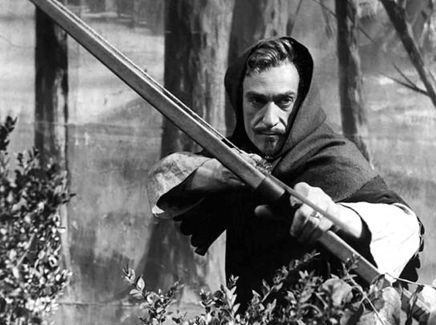
This 1953 Robin Hood series stars Patrick Troughton as Robin, an actor best-known for his later role as the second Doctor in Doctor Who.
In a 1973 TV interview, Troughton recounted how the backdrop was once put in wrongly, so the trees of Sherwood were facing sideways. And that went out live -- mistakes and all. At least one episode of this series still exists.
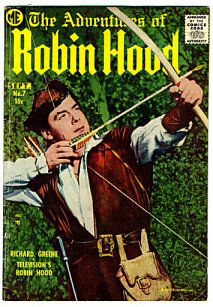
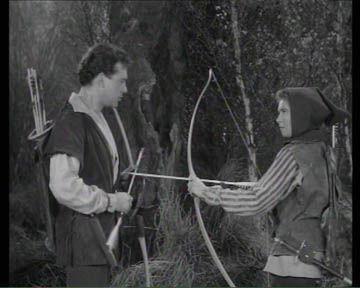
The best-known Robin Hood TV show is the 1950s The Adventures of Robin Hood starring Richard Greene. The show was written by Americans unable to work under their own names in McCarthyist America, including Ring Lardner Jr. and Ian McLellan Hunter who used a variety of pseudonyms. (The HBO TV movie Fellow Traveler written by Robin Hood film expert Michael Eaton offers a somewhat fictional account of the blacklisted writers working on the programme.)
This slightly left-wing Robin is described by Knight as a "squadron leader Robin Hood", as he is written much like a British army officer. Greene was not as energetic as Flynn or Fairbanks, but he did have leadership qualities.
This black-and-white series was very well-written (more of an emphasis on plot than character, however) with many episodes adapting ballads and some based on historical laws, such as "A Year and a Day" and "Hue and Cry".
The theme song ("Robin Hood, Robin Hood riding through the glen") was very famous, and is also known to Monty Python fans as the basis of the Dennis Moore song.
 >
>
The Greene series featured a troupe of regulars who turned up week after week in new roles or sometimes playing different parts in the same episode. Victor Woolf who played a recurring Merry Man called Derwent turned up in several other parts, and Paul Eddington was promoted from stock player to the series' third Will Scarlet. Even former TV Robin Hood Patrick Troughton played different roles in this series. The regular cast of Richard Greene, Bernadette O'Farrell (Marian), Patricia Driscoll (Marian in the 3rd and 4th seasons), Archie Duncan (Little John), Alexander Gauge (Tuck) and Alan Wheatley (the Sheriff of Nottingham) were all enjoyable.
It's not surprising that this programme is so fondly remembered by people of that generation.
In 1964, singer/actor Frank Sinatra added "My Kind of Town (Chicago Is)" to his impressive canon of songs. The tune was written by composer Jimmy Van Heusen and lyricist Sammy Cahn as part of the score for Robin and the 7 Hoods. In the movie, Sinatra played Robbo - a Prohibition-era gangster who acquired a Robin Hood reputation.
Four years later, Van Heusen and Sammy Cahn were back composing tunes for the original Robin Hood as part of a planned musical extravaganza on NBC TV which aired February 18, 1968. The Legend of Robin Hood features David Watson as Robin and Lee Berry as Maid Marian. But the true acting royalty in the cast were ... the royals. Roddy McDowall plays Prince John (a role he'd play again in a different project) and the musical's King Richard is Douglas Fairbanks, Jr. -- son of the Robin Hood of 1922. This version was less well received than Fairbanks Sr.'s Robin Hood. The New York Times review the following day remarked "It wasn't a bad musical; it was genuinely awful." (That harsh review was still kinder than the reviews the 1960s stage musical Twang!! received.)
The legend also received a sci-fi updating with Rocket Robin Hood -- a cartoon largely forgotten by American viewers but it lived on in reruns in Canada for decades. (It could well be argued that this website, written by a Canadian, wouldn't even exist if Rocket Robin's robbing from the "cosmic rich to give to the astro poor" hadn't entranced his youthful imagination.)
Two Robin Hood TV shows appeared in 1975 and they couldn't be more different from one another. It's a sign of the different directions the legend can take.
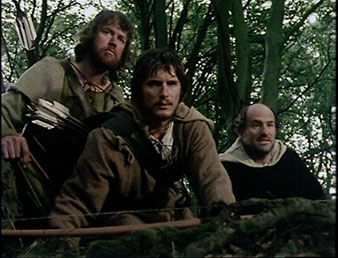
The Legend of Robin Hood
BBC TV, 1975
Martin Potter as Robin Hood
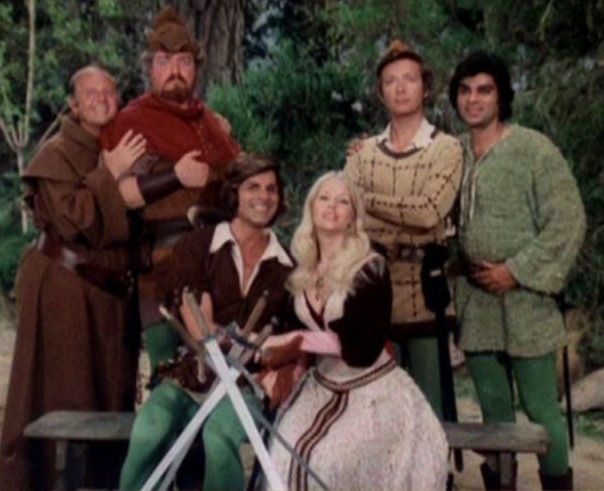
When Things Were Rotten
Paramount for ABC TV, 1975
Dick Gautier as Robin Hood
The BBC produced The Legend of Robin Hood. It was a slightly-dry but largely enjoyable mini-series starring Martin Potter as Robin Hood, the Earl of Huntingdon, and based on several ballads. Paul Darrow -- best-known as Avon in Blake's 7 played a scheming Sheriff of Nottingham, and the dour final episode is reminiscent of Darrow's later series. For one of the few times on film, the Prioress (Gisborne's sister) kills Robin. Tuck, Much and another outlaw also die in the last episode, and Will Scarlet was killed earlier in the series.
The same year as the Potter series, in America, Mel Brooks (over 15 years before he did Men in Tights) produced the much whackier TV series When Things Were Rotten starring Dick Gautier as Robin. This show was a pantomime version of the legend with shout-outs to 1970s pop culture. For example, one of Robin's opponents in the archery contest is Sir Ronald of Lord McDonald's Golden Archers (with over 1,000,000 arrows dispatched according to the back of his tunic.) Bernie Kopell's Alan-a-Dale would often break the fourth wall and address the TV viewers. When Robin and Marian kiss, he turns to the camera and says "Wanna talk about love, folks? Take a gander at Cupid's finest work."
The show works on the level of the English stage panto tradition or the American vaudeville tradition, and largely succeeds thanks to its delightful cast, including Henry Polic II's Sheriff of Nottingham. However, it was more expensive to produce than other sitcoms and was cancelled after only 12 weeks.
It wasn't the last time that a serious production of Robin Hood would face competition from a parody version.
In 1984 two television productions premiered. One of them is fondly remembered and will be discussed below. The other is not so much not fondly remembered as not remembered at all. It's The Zany Adventures of Robin Hood, a TV movie starring George Segal as Robin Hood.
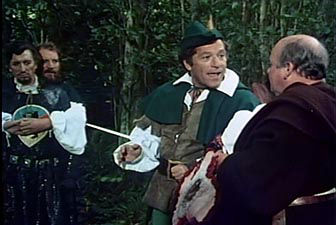
It mostly sends up the Errol Flynn film. At the climax of movie, Prince John attempts to have himself crowned king. The dialogue is recycled straight from the 1938 movie. But when King Richard interrupts the service and opens his monk's disguise someone in the audience shrieks "It's a flasher!" Tom Baker's Sir Guy of Gisbourne returns to the 1938 script by saying "It's a trick of the outlaws!" At the film's end, King Richard is enraged to learn of all the promises that Robin Hood made to secure the king's ransom money -- equal rights for women, unemployment benefits and the creation of the state of Israel.
Morgan Fairchild plays Maid Marian. Roddy McDowall and Robert Hardy (not only a great character actor but a real-life expert on the medieval longbow) play the feuding brothers Prince John and King Richard. Both of the boys are cowed by their domineering mother Eleanor of Aquitaine, played by Janet Suzman.
Perhaps the best, certainly the most innovative, Robin Hood TV series is 1980s Robin of Sherwood (1984-1986).
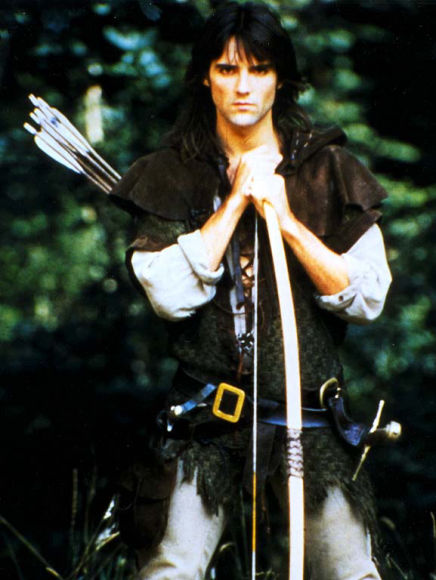
Here, Robin Hood is Robin of Loxley, a young peasant and servant ("son") of the Celtic Horned God, Herne the Hunter. It taps very much into the mythic themes categorized by folklorists such as Lord Raglan and Joseph Campbell.
For the first two seasons, Robin was played by Michael Praed, who gives the character a perfect fey and messianic quality. If Richard Greene's Robin Hood is a squadron leader, this Robin Hood is a student protest leader.
Even though this Robin Hood fought devil-worshippers and sorcerers in addition to the sheriff, Robin of Sherwood had a distinctly anti-Thatcher tone.
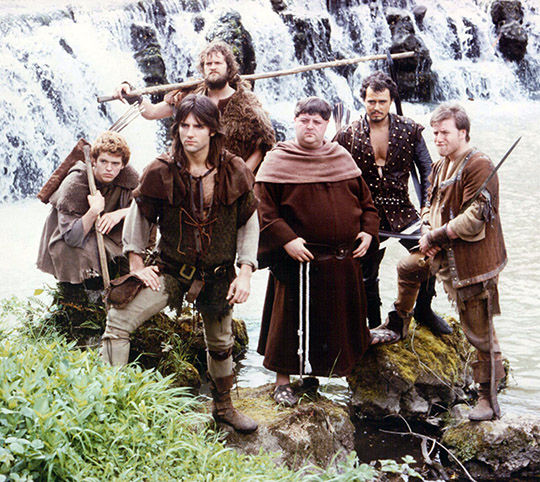
The show's Marion played by Judi Trott lived and fought alongside the outlaws. Ray Winstone (later to feature in several Hollywood films) is memorable as a very angry, almost psychotic, Will Scarlet. And fans have often suggested than Alan Rickman's 1991 take of the Sheriff of Nottingham owes much to Nickolas Grace's sheriff from the 1980s TV series.
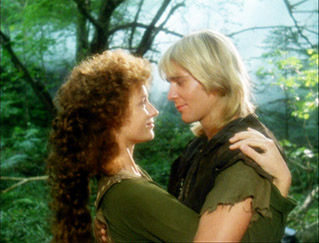
When Praed left the show, he was replaced by Jason Connery.
But they didn't merely recast the part. As you'll have seen from reading this page, there have been many different Robin Hoods. Series creator Richard Carpenter tapped into that. Loxley was killed, and Herne chose a new son in Jason Connery (son of former Robin Hood and James Bond, Sean) as Robert, son of the earl of Huntingdon.
At the beginning of the third series, Robert gathers Loxley's scattered band back together, and they fight the good fight anew. The peasants call Robert of Huntingdon "Robin Hood", and soon the outlaws and even Marion do so too.
The show has a touch of historical realism common to many recent Robin Hood versions. Writer Richard Carpenter weaved real medieval details into his adventure fantasy. And although John Rhys-Davies doesn't look like the historical King Richard, by god, he acts like the Lionheart.
And Robin of Sherwood added a key element to the legend.
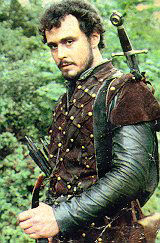
The villain in the opening story of Robin of Sherwood was an evil sorcerer who had a Saracen (Muslim) servant. Originally, the servant was to be be killed off. But actor Mark Ryan was so liked on the set, that the ending was re-written. Former assassin Nasir Malik Kamal Inal Ibrahin Shams ad Duala Watthab ibn Mahmud ("Is that a name or a family tree?") reformed and joined the outlaw heroes. Islamic characters had been bad guys in 19th century Robin Hood novels and pantos, but this was the first heroic Islamic member of the merry men.
Strong, silent Nasir wasn't just a big hit with the show's fans. Other producers liked the idea of an Arab band member. After Nasir came Barrington, a black Rastafarian played by Danny John-Jules in Maid Marian and her Merry Men.
Then, after these two TV series blazed a trail of originality, Prince of Thieves created the Moor, Azeem. (He was originally named Nazeem until apparently the Robin of Sherwood lawyers had a word or two with Costner's producers.) Azeem was parodied as Achoo and Asneeze in Men in Tights. And the 1990s The New Adventures of Robin Hood series had a black martial artist named Kemal. Yet more variations followed.
Even though he varies in name and nature (and now gender), the Islamic character seems to have become a permanent addition since his first appearance, only about 30 years ago. This is evolution in my lifetime.
It's a testament to Robin of Sherwood's enduring popularity that the entire surviving regular cast reunited in 2016 for The Knights of the Apocalypse, an audio drama adapted from Richard Carpenter's script for a proposed TV or film reunion.
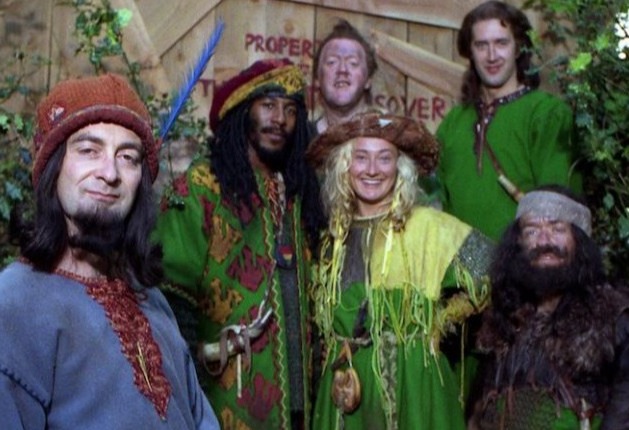
Maid Marian and Her Merry Men is a 1989-1994 BBC children's series, and a feminist satire. The show is the brainchild of writer Tony Robinson who also plays the Sheriff of Nottingham. Kate Lonergan plays a Marian who is both the brains and brawn of her outlaw band. Unfortunately the vain and foolish Robin of Kensington (Wayne Morris aka Adam Morris) tends to get most of the credit. The show sends up pop culture -- for example, Robin has an evil lookalike, Clem Costner.
It's fondly remembered by a generation of children. Each episode features songs, and Barrington's song "Pancake Day" still gets played every year at Pancake Day/Mardi Gras.
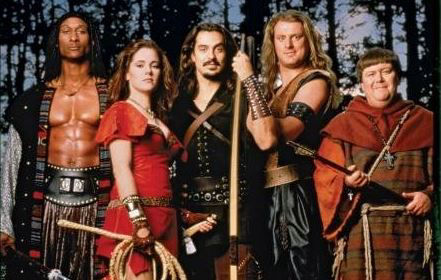
Back in the 1990s, Hercules: The Legendary Journeys and its spinoff Xena: Warrior Princess were cult hits for their witty, almost parodic adventures. The super station TNT tried to cash on their success by offering the suspiciously similar The New Adventures of Robin Hood in 1997 Matthew Porretta (Will Scarlett O'Hara in Men in Tights) plays Robin in the first two seasons. It continued in syndication for another two seasons, but with John Bradley as Robin.
It's barely remembered today. The 1991-1992 cartoon series Young Robin Hood and the 1998 Canadian children's series Back to Sherwood might be even less remembered.
The outlaw hero continues to appear on 21st century television.
The Princess of Thieves TV movie appeared on ABC's long-running The Wonderful World of Disney programming block in 2001. Keira Knightley plays Robin Hood's daughter Gwyn. She struggles to both win her father's acceptance and install King Richard's son Philip (actor Stephen Moyer) as the new king of England.
In 2005, Doctor Who returned to TV -- Saturday nights on the BBC and was an even bigger hit than anticipated. The BBC looked for other shows to capture a similar family audience for the weeks when Doctor Who wasn't on the air.
Showrunners Dominic Minghella and Foz Allan billed described their 2006 Robin Hood TV series as "Robin Hood for the Playstation Generation". This Robin Hood modernized the Middle Ages. Jonas Armstrong's youthful Robin wore something that resembled a 21st century hoodie. Richard Armitage's Guy of Gisborne (the show's true breakout star) wore something that resembled a leather duster.
The love triangle between Robin, Guy and Lucy Griffith's Marian was strong element in the first two seasons. The third season struggled and was cancelled -- with the finale airing on the secondary channel BBC Two.
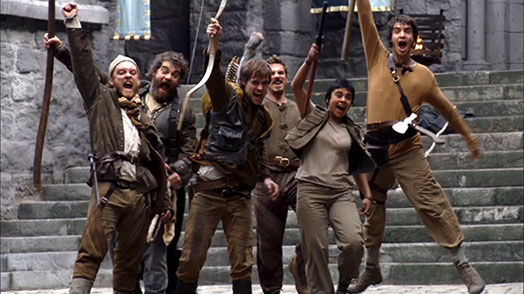
Once again, Robin is a returning crusader, and this time (as with the movies that would follow over the next dozen years), the Crusades were a stand-in for the then current Iraq War. While Robin supported King Richard, he did question England's involvement in the war. The suppression of civil liberties (such as the Patriot Act in the US) are also explored through metaphor ... when the outlaws weren't trying to rob a suspiciously modern casino. (One of many elements that the 2018 Robin Hood film lifted from the 2006-2009 TV show.)
In its fifth episode, the show introduces yet another Muslim outlaw -- Djaq. Although Djaq dresses as a man for the first season, this new Saracen character's birth name is "Safia" and she's played by actress Anjali Jay.
The show approached the past with colour-blind casting. Tuck was played by Black actor David Harewood -- one of the highlights of Robin Hood's final season.
A 2010 TV movie Beyond Sherwood Forest starring Robin Dunne and Erica Durance recast Robin as a dragon-slayer with special effects that seemed straight out of a video game. (Which is the perfect segue to the section below on video games, but if you want to learn about more recent Robin Hood television shows (such as the 2025 Robin Hood series on MGM+), films and novels, you can skip ahead to this page.)
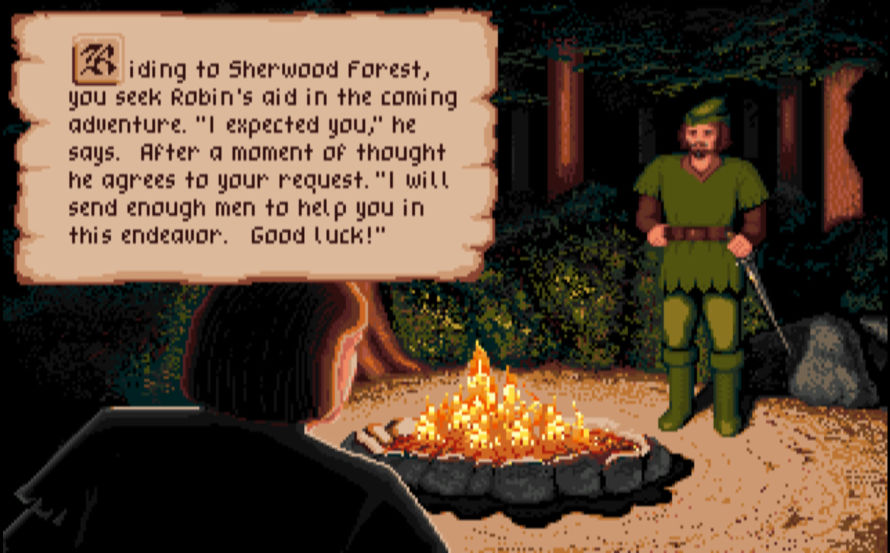
Defender of the Crown
(Amiga Version)
Cinemaware, 1986
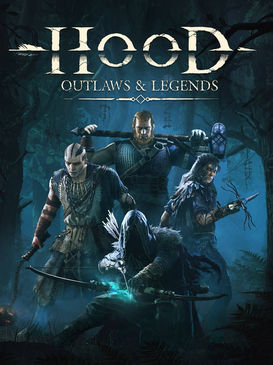
Hood: Outlaws & Legends
Sumo Newcastle / Focus Home Interactive, 2021
The Robin Hood legend has been well-represented in video games.
Users of Commodore 64 and ZX Spectrum spent many hours running through forest mazes in the 1985 game Robin of the Wood. And Commodore's Amiga computer line got a big push in 1986 with the release of Cinemaware's Defender of the Crown -- a game inspired by Sir Walter Scott's novel Ivanhoe which showed how video games could be an immersive experience. If users needed help raiding the castle, they could visit Sherwood Forest three times and call on Robin Hood for aid. Defender spawned many sequels and spinoffs -- including a 2003 spinoff for Windows, XBox and Playstation that shifted focus to Robin Hood.
One of the most popular computer games of 1991 / 1992 was Conquests of the Longbow: The Legend of Robin Hood from Sierra On-Line. Christy Marx's script incorporated many elements of the Robin Hood tales, and also included Pagan imagery as players could get help from the Green Man.
Players could also relive their favourite movies and TV shows with spinoff games for Robin of Sherwood (Robin of Sherwood: The Touchstones of Rhiannon in 1985 for various home computers) and Robin Hood: Prince of Thieves (for NES and the Nintendo Game Boy in 1991).
21st century Robin Hood video games include the award-winning Robin Hood: The Legend of Sherwood in 2002 and 2021's Hood: Outlaws & Legends. Robin Hood novelist Steven A. McKay contributed to the 2021 game which offers new takes on Robin Hood (The Ranger), Marianne (The Hunter), John (The Brawler), and Tooke (The Mystic). The game has a fantasy element, not uncommon in the modern legend, but is also more urban in its setting.
Although magic wasn't a feature of the Robin Hood ballads, it's been a part of the legend for centuries from the evil witch and Puck-Hairy in Jonson's play to traditional pantomine magic to the Arthurian novel, The Sword in the Stone, where the Merry Men join a young Arthur in fighting Morgan le Fay.
But it's become even more common in recent years when novels by people like George R.R. Martin score high on the best sellers' list. The 1980s Robin of Sherwood TV series with the benevolent Herne the Hunter as a spirit guide and evil sorcerers as bad guys did much to popularize the mystical side of Robin Hood.
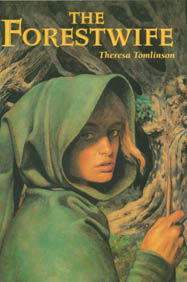
Novels like Clayton Emery's Tales of Robin Hood have magic running through them. While it's not magic in the fireball-throwing sense, Marian's portrayal as an herbalist in Theresa Tomlinson's Forestwife Trilogy is a part of this trend. Nancy Springer features the half-elvish daughter of Robin Hood in her Rowan Hood series. Dark and light magic feature in Debbie Vigule and James R. Tuck's Robin Hood: Demon's Bane book series. These are but a few examples. Others include the Books of the Wode series by J. Tullos Hennig and the Blind Bowman series by Tim Hall.
And Robin Hood has made appearances alongside other storybook fantasy characters in the 2001 movie Shrek (with a French accent for some bizarre reason) and the 2003 graphic novel Fables: The Last Castle, based on the popular comic book series Fables, written by Bill Willingham. Robin Hood has even fought zombies in various novels, films and comic books.
Even Robin Hood novels where there's little overt magic, like Sherwood by Parke Godwin and Robin McKinley's Outlaws of Sherwood, are placed in the fantasy section. There's a strong element of Celtic folklore in Stephen R. Lawhead's 2006 novel Hood which recasts the hero as a Welsh freedom fighter.
Robin Hood has also appeared in the sister genre of fantasy -- science fiction. In Esther Friesner's 1995 novel The Sherwood Game, Robin and his band are smart, self-aware computer programs who get up to their old tricks in the real world, and discover a few new tricks too. Robyn Loxley, a 12-year mixed race heroine, keeps the outlaw tradition alive in the repressive and futuristic Nott City in Kekla Magoon's 2015 novel Shadows of Sherwood. In the 1960s, Rocket Robin Hood was a cheesy yet classic cartoon starring Robin's descendant from the 30th century. News broke in 2016 that an upcoming futuristic Robin Hood film by writer Tony Lee will be set in a dystopian future London, although the box office failure of the 2018 Robin Hood film appears to have dimmed prospects of that being made.
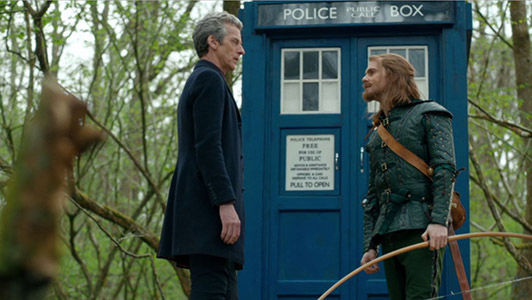
And of course, more than a few time travellers have made their way to medieval Sherwood. Perhaps the most famous example is the 1981 move Time Bandits which features a foppish "Robin Hood as played by the Duke of Kent" played by John Cleese, a satire of clueless aristocrats greeting the public. Other examples include, a 1990s children's programme Back to Sherwood has a modern-day girl travel back to team up with the Merry Men's children.
The Doctor, that famous television time-traveller, joins a bunch of futuristic fans of old Earth - among them Robin "Bingo" Lockesley, Lord Sherwood -- to compete for a silver arrow on a planet called Flynn in Michael Moorcock's novel Doctor Who: The Coming of the Terraphiles. The Doctor finally encountered Robin Hood in the 2014 episode "Robot of Sherwood". (In DC Comics alone, Green Arrow, Batman, Robin, The Flash (Jay Garrick), Wonder Woman, Rip Hunter -- Time Master and Lois Lane have met Robin Hood through time travel.) In the next section, Robin Hood mingles with the superheroes on their own turf -- comic books.
CHANGES TO THE LEGEND:
PART 7: COMIC BOOKS AND COPYCATS (20th-21st centuries)
PART 8: ROBIN HOOD IN THE PRESENT AND THE FUTURE (21st century)
INDEX: WOLFSHEAD THROUGH THE AGES - THE HISTORY OF ROBIN HOOD (Index page)
ROBIN HOOD: THE EARLY YEARS
PART 1: BALLADS AND BACKGROUND (13th-15th centuries)
PART 2: MAY GAMES AND MAYHEM (13th-16th centuries)
CHANGES TO THE LEGEND:
PART 1: EARLDOMS AND ELIZABETHANS (16th-17th centuries)
PART 2: PROTESTANTS AND PROPAGANDA (17th century)
PART 3: BROADSIDES AND BUFFOONERY (17th-18th centuries)
PART 4: REVOLUTIONS AND ROMANTICISM (18h-19th centuries)
PART 5: CHILDREN'S NOVELS AND COMIC OPERAS (18th-20th centuries)
Click here to view the sources used to write Wolfshead through the Ages: The History of Robin Hood.
Sources for this specific section can be found here:
Text copyright, © Allen W. Wright, 1997 - 2025.
The Robin of Sherwood photos are courtesy of Spirit of Sherwood and are used with permission.
Sean Connery as Robin from Robin and Marian is © copyright to Columbia Pictures, 1976, and is used without permission for purpose of criticism and review.
The images of Daffy Duck, Errol Flynn and Kevin Costner are © copyright, Warner Bros [and Turner Classics in Flynn's case]. They are used without permission for the purposes of review and criticism.
The Richard Greene comic book cover is © Sussex/Magazine Enterprises, 1955. The company folded decades ago.
The 1953 Robin Hood, The Legend of Robin Hood and Maid Marian and Her Merry Men are © copyright BBC and the 2006 Robin Hood series is © copyright BBC/Tiger Aspect. They are used without permission for the purposes of review and criticism.
The 1952 Story of Robin Hood and His Merrie Men and the 1973 animated Robin Hood are © copyright Walt Disney Corporation. They are used without permission for the purposes of review and criticism.
The 1991 Robin Hood movie with Patrick Bergin and Robin Hood: Men in Tights are © 20th Century Fox. They are used without permission for the purposes of review and criticism.
When Things Were Rotten is © CBS Studios (CbS/Viacom/Paramount). Pictures are used without permission for the purposes of review and criticism.
Photos of the 2010 Robin Hood movie were provided by Universal Pictures's publicity department, but any continued use is under the principle of fair use.
All other images are used without permission for the purposes of review and criticism under the principle of fair use. Copyright is with the respective rights holder.
Contact Us