Introduction
Characters and Actors
Writers and Episodes
Lyrics to the Theme Song
Merchandise, Movies and More
Airdates
Links to Other Sites
Sources
Order Episodes on Video and DVD
Current Spotlight
All Spotlight Reviews
Novels and Short Stories
Films and Television Shows
Plays, Poems and Ballads
Robin Hood Scholarship
Miscellaneous
Featured Spotlights
Robin Hood - Prince of Thieves
starring Kevin Costner
The Adventures of Robin Hood
starring Errol Flynn
Robin of Sherwood
starring Michael Praed and Jason Connery
The Forestwife
by Theresa Tomlinson
A Gest of Robyn Hode
(early ballad)
Robin Hood and the Friar
(16th century play)
Robin Hood Tales
(1950s comic books)
Main Sections
Main Page
Introduction & What's New
A Beginner's Guide
Robin Hood Tales
- Ballads & Stories
Wolfshead Through the Ages
- The History of Robin Hood
Search for a Robin Hood
Spotlight of the Month
Robin Hood - A Personal Journey
The Picture Gallery
Interviews in Sherwood
The Blue Boar Inn
- Message Board
Legendary Links
Pook's Hill
Information
Site Map
How to use this site
Search This Site
About the Author
My Biography
Send me an e-mail
Copyright
All text, unless otherwise noted, and title graphics - © copyright Allen W. Wright, 2005.
The Adventures of Robin Hood was initially made by Sapphire Films / Official Films. The current UK copyright is held by Carlton International. The DVD release is by Network Video. Images are used without permission under fair use for the purpose of criticism and review.
|
The Adventures of Robin Hood
Television Series
Starring Richard Greene, Bernadette O'Farrell, Patricia Driscoll, Archie Duncan, Alexander Gauge and Alan Wheatley
(A Sapphire Films Ltd Production for ITC Entertainment)
Aired 1955 - 1960 on ITV in the UK
Aired 1955 - 1959 on CBS in the USA
Robin Hood, Robin Hood
Riding through the glen.
Robin Hood, Robin Hood
With his band of men.
Feared by the bad, loved by the good.
Robin Hood, Robin Hood, Robin Hood.
There's a common mistake made in North American articles about British television. They refer to the entire televisual output of Great Britain as being from the BBC. Time and again, The Adventures of Robin Hood and Robin of Sherwood have been called BBC programmes. Of course, those in the UK know that the BBC isn't the only broadcaster in the land. But that wasn't always the case.
The 1955 television series The Adventures of Robin Hood starring Richard Greene was one of the first shows to appear on ITV, the UK's first commercial channel. The Adventures of Robin Hood - and ITV - is now celebrating its 50th anniversary, and so it's appropriate to take a look back at the TV series which defined Robin Hood for at least a generation or two.
The series lasted four seasons and 143 episodes. It was nigh-impossible to achieve swashbuckling action on a TV budget and fast filming schedule. But despite the technical problems, there is a lot of merit in this old series.
The Spotlight article is divided into several sections.
Richard Greene's Robin is not the swashbuckling Robin of Errol Flynn or the student
radical Robin of
Michael Praed. It's not that there isn't a bit of trickster to this Robin. You do seem a
gleam in his eye on
occasion. But it's a much safer sense of humour than that of other Robins. There's
something very safe
and reassuring about Greene's Robin Hood – not entirely unlike the good-natured, father
figure that
Batman was in 1950s comics. Film historian Jeffrey Richards had called him "everyone's
favourite
uncle", and drawing the obvious comparison to a World War II officer, Stephen Knight has
dubbed
him "squadron leader Robin Hood". As Knight explains, the Robin's paternal nature fits the
welfare state
of 1950s Britain. In some ways, Greene feels like a grown-up version of the youthful
Robin Hood of Richard Todd in the 1952 Disney film The Story of Robin Hood
and his
Merrie Men.
As an uncle or father figure, Greene presides over a likeable family of Merry Men. They
are mixture of
kindly uncle figures and overgrown children – who like Peter Pan's Lost Boys never quite learned how to grow up.
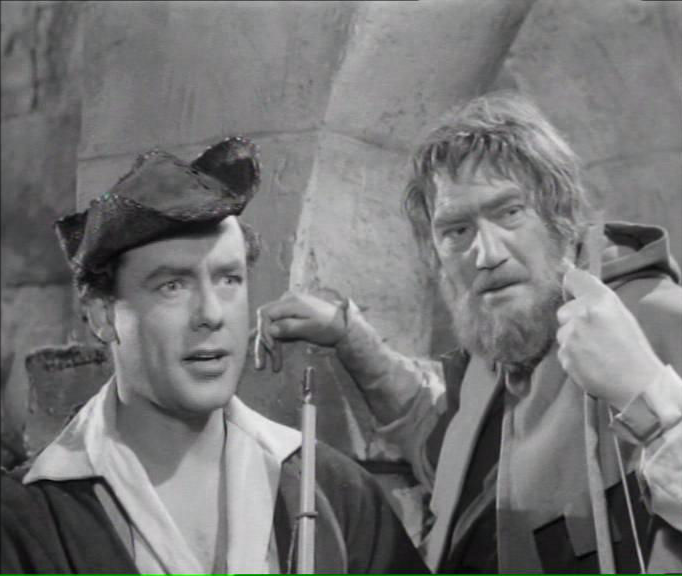
Little John, played by Archie Duncan, is a fairly amiable lieutenant and playground friend,
despite – or perhaps
because of - the character's hot temper and dim wits. Duncan brought the same likeability to his role
of Inspector
Lestrade in the 1950s Adventures of Sherlock Holmes TV series. But Duncan was less
sympathetic in his first appearance in the Robin Hood legend when he played Red Gill –
killer of Robin
Hood's father – in the 1952 film. The real-life Duncan was more a hero than villain. He
was replaced for
five episodes by Rufus Cruickshank as Duncan was off recovering from injuries sustained
while rescuing
some children from a mishap on set.
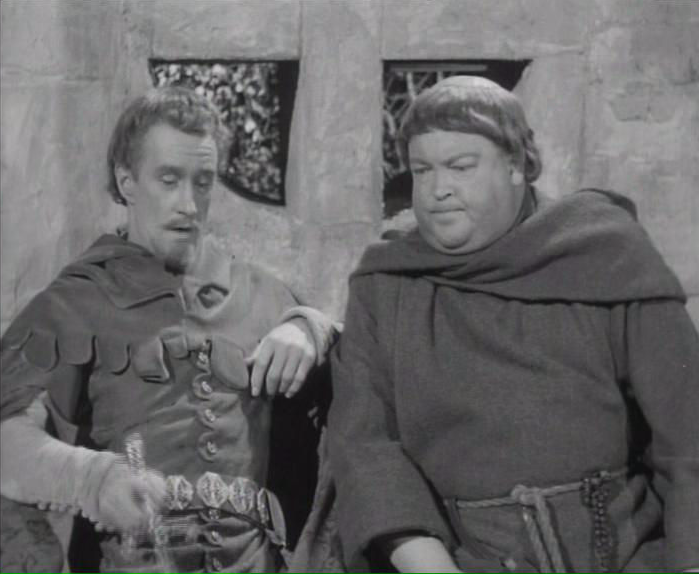
Alexander Gauge plays Friar Tuck – Alfred Tuck, to give the character's full name – as a
bit of den
mother or school marm. Tuck sometimes blusters at Robin and his men. Along with Marian,
this Friar
Tuck played the role of a spy – his connection to the outlaws was suspected, but not
confirmed. So, he
could pass information to Robin, give sanctuary to fugitives and give aid to the poor and
oppressed of
the town. Generally a more respectable Tuck than some, Gauge's interpretation still takes
great delight
in more food and ale than a proper holy man might.
Much the Miller's Son is a minor character in this TV series appearing in a few episodes,
played by
different actors. But the mascot function of the character is ably handled by a new
character, the
diminutive Derwent played by Victor Woolf. The Adventures of Robin Hood had
a repertory of guest actors. Folks like John Dearth, Willoughby Gray and Paul Eddington
played dozens
of parts in the series. Woolf was amongst them. Even though his Derwent – or Cedric, in
the early
episodes – was a regular character he still played guards, clerks, seedy tavern owners.
Sometimes
Woolf played more than one role in the same story (apparently he played four different parts in one story).
In the fourth and final season, Paul Eddington also made the transition from perpetual
guest star to
series regular when he became the new Will Scarlet. The character appeared in two episodes
of the
first season played by Ronald Howard (who also played Sherlock Holmes opposite Archie
Duncan). The
dandy, fashion-obsessed Will of Winchester initially rejected the outlaw way of life
because Lincoln
green just wasn't fashionable. Will got in trouble for his philandering, which including
cuckolding the
sheriff by seducing his girlfriend and then hiding under the bad guy's bed. Forced into
the outlaw life,
the name Will Scarlet was chosen to remind everyone of his old dress sense. Eddington's
Will appeared
in "The Lady-Killer", highlighting his flirtatious behaviour. But soon the character
settled down and was
considered a wiser member of the band than Little John. Starting with the episode "Six Strings to His Bow", Will was paired up with Alan a Dale
played by Richard Coleman.
And as usual, the Merry Men wouldn't be complete without an uncommon woman - or I should say uncommon women as two
actresses
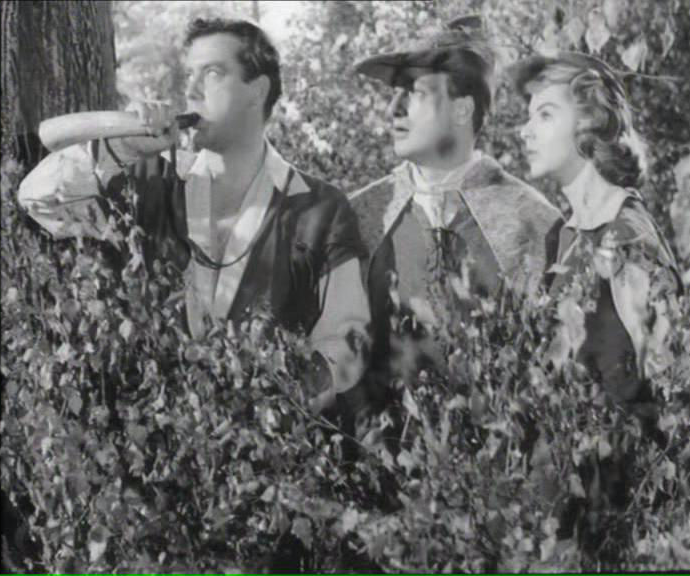
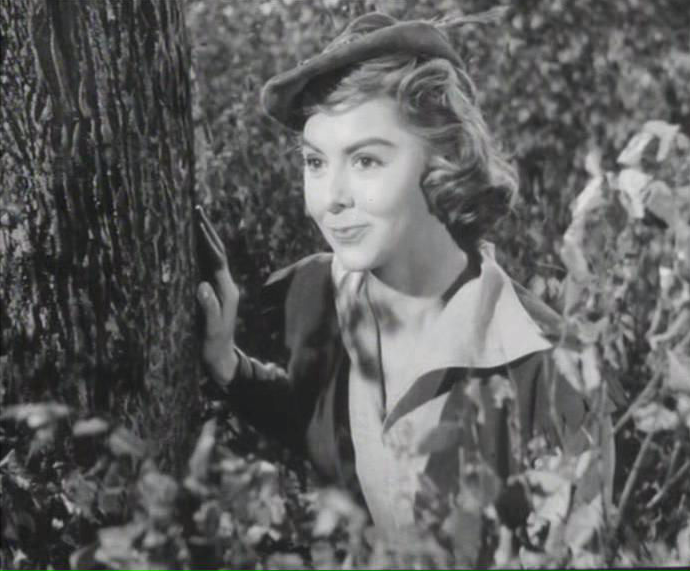
played the role of Maid Marian. Bernadette O'Farrell played the Lady Marian Fitzwalter in the first two seasons. Much like the Olivia de Havilland version of the character, this Marian acted as a spy for the outlaws by maintaining connections with the court. However, the TV Marian took an even more active role in events. When she first encounters Robin's band, Marian proves her worth by outwrestling and outshooting a Merry Man. It's said more than once that her archery skills are equal to Robin's. It is the 1950s, and so we don't get to see her in action as much as some Marians, but she often hangs out at the outlaw's camp in a uniform not unlike Robin's own. An early episode establishes her fondness for boy's clothes. For the 1950s, O'Farrell's Marian is a very strong female character. Maybe that shouldn't be so surprising when the series had a female executive producer in Hannah Weinstein and a woman apparently wrote Marian's "origin" story. (The episode is credited to Anne Rodney. But given the frequent use of pseudonyms by the writing staff, it would be hard to know who was actually responsible for the episode.) Stephen Knight has called this Marian "a highly capable ATS officer", referring to the women's auxiliary in World War II.
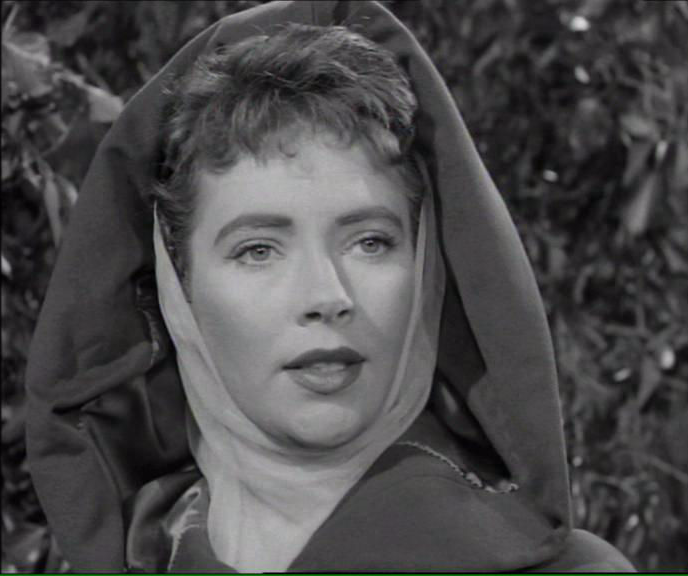
In the third and fourth seasons, Marian was played by Patricia Driscoll. Some fans have complained that Driscoll didn't have the proper bearing that daughter of the Lord of Fitzwalter Hall would have. Maybe not, but what she lacks in aristocratic airs, Driscoll more than makes up for in her tomboy and pixy charm. The Robin Hood-style outfit suits Driscoll very well.
The Sheriff of Nottingham was played to villainous perfection by Alan Wheatley. He schemed and double-crossed his way to defeat each week. One of the sheriff's blind spots was his obvious affection for Maid Marian. He didn't pursue Marian with the vigour that evil suitors usually did, but his fondness for Marian did blind the Sheriff to her true allegiances. The sheriff's replacement wasn't that interested in Marian, nor was he fooled by her. In the fourth season, the regular sheriff departed for London and was replaced by the Deputy Sheriff, played by John Arnatt. Arnatt seemed wiser and more dangerous than Wheatley's Sheriff. And in the 1967 film A Challenge for Robin Hood starring Barrie Ingham, Arnatt would return as the full Sheriff of Nottingham.
There's yet another cast member who appeared elsewhere in Robin Hood films. Ian Hunter was the King Richard who pardoned Flynn's Robin in the 1938 The Adventures of Robin Hood. In this show, Hunter seems to have been demoted as now he's Sir Richard of the Lee (straight from the early printed ballad A Gest of Robyn Hode), a friendly but sometimes troublesome ally to Robin. Although he didn't appear in the first episode, Hunter was credited in the TV Guide listings for it. Apparently, his name had some value. Also missing from the first episode, but receiving credit was Donald Pleasance, one of a few actors to play Prince John in the TV series. Of course, the TV series also had many guest villains, often robber barons in the upper class twit mode. The choice of such villains was but one manifestation of the political sentiments running through The Adventures of Robin Hood.
|