|
September 2002
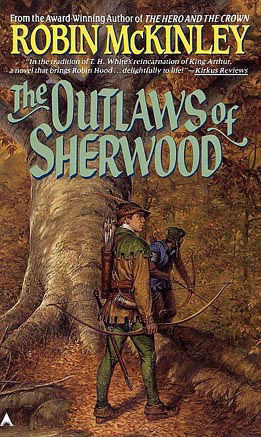
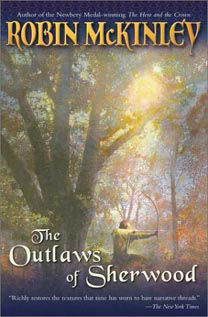
The Outlaws of Sherwood
by Robin McKinley
Greenwillow hardcover, 1988
Ace Books paperback, 1989
On his way to Nottingham Fair, a young apprentice forester named Robin
is accosted by some of his fellow foresters. Forced to flee, Robin shoots
some arrows in self-defence at his attackers. One forester is accidentally
killed. Robin is outlawed is outlawed for his crimes. He comes to live
in Sherwood Forest and assembles a gang of "honest outlaws" to plunder rich
travellers and give some comfort to the poorer Saxons. Among his band are
Marian, Will Scarlet, Little John and Friar Tuck. The outlaws rescue Alan-a-Dale's
bride from an unwanted marriage and help the friendly knight, Sir Richard
of the Lea, repay a loan and recover his lands. The outlaws make enemies
of the Sheriff of Nottingham, and the sheriff hires a bounty hunter named
Guy of Gisbourne to eliminate Robin and his outlaw band. And finally, Robin
wonders what will happen when the long-absent King Richard returns to Sherwood.
Summarized that way, it's easy to see why Stephen Knight has described
Robin McKinley's book as a "straight re-telling". But such a summary, while
accurate in the broad strokes, does not do The Outlaws of Sherwood justice.
In the classic legend, Robin Hood is a superlative archer. Here,
Robin is outlawed because he shot the forester in the heart with an
arrow intended for his foe's leg. Robin even tells one of his outlaw
band: "you pass the basic requirement, which is to be a better archer
than your leader ... Come now, that's the most open secret here, that I am
the worst archer of us all."
This change is a sign of McKinley's love of "ordinary heroes". But
Robin's inability to split a willow wand or opponent's arrow at ludicrous
distances is not the most important change in Robin's character or the biggest
example of him being an ordinary hero. Traditionally, Robin is a
trickster -- someone who might care very much about the poor that he helps,
but seems to care little for the troubles that affect him. McKinley's
Robin Hood, however, is a (justified) worrywart -- and a very charming one
at that. His often repeated slogan is that various things like philosophies
"do not keep the rain out".
In the classic legend from the Gest to Errol Flynn, Robin Hood eagerly
risks life and limb to shoot for the prize of a golden and/or silver arrow,
clearly knowing that the archery contest is the sheriff's trap. But
here, Robin has a somewhat different reaction.
Robin sighted along the shaft of his new arrow. "So?"
Marian smiled. "So the outlaws of Sherwood, renowned,
as they are, for their archery, cannot possibly stay away from such a contest."
"Why not?" said Robin, genuinely surprised.
"Why, for the golden arrow," said Marian.
"Golden arrow? And what would we do with a golden
arrow? Give it to Alan for a lute-string? I could hang it around
my neck on a chain, perhaps, and let it stab me in the ribs when I tried
to sit."
"And your honour as an outlaw?" Marian suggested.
Robin set down his arrow and laughed. "My honour
as an outlaw concerns staying alive; and presenting my neck anywhere near
the sheriff of Nottingham, who feels it wants lengthening, did he recognize
it, runs directly counter to that honour. Besides, you know I can't
shoot a pig's sneeze."
-- p.112 (Ace Books edition)
Robin seems very aware with the negative consequences that come with the
sort of life that he leads. His worrying comes from a sense of responsibility
and leadership. However, Robin often seems to overlook the more positive
aspects of his outlaw life. Concerned with the safety of his band,
Robin often fails to see the importance that his legend has. While
Robin might view himself as ordinary, he is still at the root of something
extraordinary. He may not be able to shoot as far or as accurate as
his legendary counterpart, but McKinley's Robin is, in his own way, still
quite an extraordinary hero. Fortunately, others in his band realize
this. The Merry Men provide far more than skill with the longbow. They
also support Robin emotionally.
The Outlaws of Sherwood is a very appropriate title for this book. McKinley
gives much attention to the others in Robin's band of Merry Men and Women
(for McKinley has added several female characters). Little John, Will
Scarlet, Much, Tuck, Alan a Dale and his wife Marjorie, a mysterious lad
named Cecil (whose secret is revealed elsewhere on this website) -- they all
get their time to shine. And of course, Marian -- how could we forget
her? Unfortunately, several writers have done just that.
In several of Marian's earliest appearances in the Robin Hood legend, she
is a very capable
archer
and huntswoman
. And in
her only major ballad appearance
, a disguised Marian fights Robin to a standstill. Even into the 19th
century, Marian is an effective fighter, as in Thomas Love Peacock's novel
Maid Marian
. But in many 19th and 20th century children's books, Marian's character
had been weakened into only being Robin's girlfriend with no apparent fighting
skills. (One scholar has suggested that Marian's character was softened
as the suffragette movement gained strength and strong woman seemed more
politically threatening.) It's unfortunate that many people still think
that Marian should be shy, retreating, helpless. Fortunately, McKinley's
Marian is one of many modern attempts to restore some strength and vitality
to the character. Yes, Marian can easily outshoot Robin (in this book
-- who can't?) But again, she's far more than merely a good huntswoman. Much
of the spirit, the emotional heart, of Robin's legend (within the book) comes
from Marian. In terms of personality, McKinley's Marian is as strong
as she's ever been -- making great personal sacrifices for the sake of the
outlaws and their reputation.
Speaking of sacrifice -- in the ballads, Robin can fight with people for
hours, get his skull split with blood flowing out. And still you get
the impression that he's never really hurt. After seeing too many action
movies with rapid recoveries, it's a relief to see that McKinley knows there
are other possible outcomes to swordplay than just dramatic deaths or nice-looking,
fast-healing and unimportant scars.
McKinley's book is a well-written, highly readable tale which is (mercifully)
not written in the pseudo-medieval English of some Robin Hood books. It's
worth reading this book to see her fresh approach to the characters, and to
encounter characters unique to this book -- such as Cecil -- who make you
wish they'd always been a part of the legend.
My own real criticism is the very, very end of the book. Not the part
that Robin McKinley describes in her interview as being the hardest part to
write. I mean the last few pages. People familiar with the book
might wonder why, as it reflects something that's been part of the Robin Hood
tradition from the Gest on down. Well, the Gest resolves this matter
in a way lost on most later versions -- and those later re-tellings also
trouble me. (I will discuss this subject in a future spotlight.) Plus,
there's my personal reaction to a certain historical event (and contemporary
parallels) that colours my response to the ending. The ending really
bothered me when I first read the book in 1989, but less so now. I
can see that the tone is not so upbeat as to make such an ending truly insufferable.
Of course, my unease could be resolved with an Outlaws Part Two. It
would be nice to see more of Cecil again.
Read an interview with Robin McKinley
about The Outlaws of Sherwood.
Visit Robin McKinley's official
website.
Order
The Outlaws of Sherwood on Amazon.com
Order it on Amazon.co.uk
|