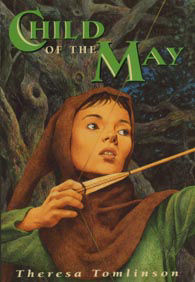
THERESA TOMLINSON
Conducted
and transcribed by Allen W. Wright
Originally from
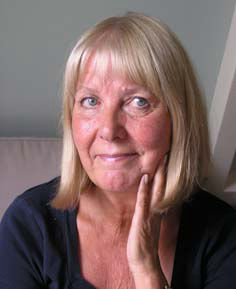
North Yorkshire, children's author Theresa Tomlinson now lives in Sheffield,
Yorkshire [Robin's legendary birthplace Loxley has been absorbed by this city].
She writes writes fiction for young adults using the history and folklore
of various Yorkshire locations -- including Cleveland, Whitby and Sheffield
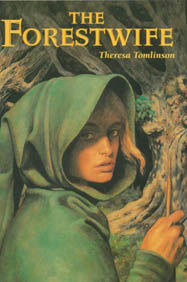
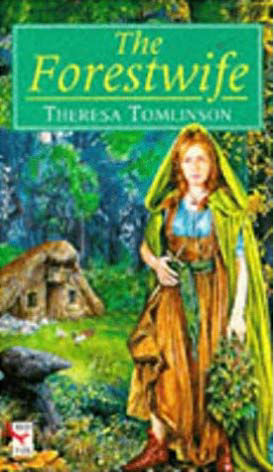
-- as well as the neighbouring Derbyshire. In 1993, she wrote The Forestwife,
a young adult novel starring Marian. Two sequels were published, Child
of the May [1998] and The Path of the She-Wolf [2000]. Click here to go to Theresa
Tomlinson's official website.
This
interview was conducted via e-mail on August 25, 2001.
AWW:
Growing up in Yorkshire, what was your first exposure to the Robin Hood
legend?
TT:
My earliest memories of Robin Hood are the weekly television series with
Richard Greene, which I think was shown all over the UK. I can still remember
the theme tune and it was one of the highlights of our week. I can remember
my brother being taken to the cinema to see the Errol Flynn film, and I was
very jealous. I think I was taken to see a ballet instead, as
Robin Hood was thought to be more of a boys' thing at the time.
The Yorkshire influence came in fairly early because as a young child we
lived just north of Whitby and outings to Robin Hood's Bay were quite regular.
I think it was my grandfather who first told me the story of Simon Wise (he
was full of local stories that still give me inspiration now) The story goes
that a man who called himself Simon Wise, took refuge in a small fishing
town called Bay Town and made friends with the fishermen. He went out fishing
with the men, even though he wasn't very good at it. One day the boat was
attacked by French pirates, Simon Wise took up his bow and a quiver full
of arrows and got his friends to tie him to the mast (I suppose to steady
himself) and he shot every pirate who tried to come aboard the fishing boat.
At last the remaining crew members capitulated and handed over the pirate
boat and its contents, which turned out to be stacked with gold. However,
Simon gave all the money away to poor fisherfolk in the area and returned
to his native country, which was Barnsdale. Simon was really Robin Hood and
the town became named after him. This was my grandfather's version. Since
then I've heard many other explanations of how the town got its name.
AWW:
I gather you played Robin Hood and Marian adventures as a child. Could you
please talk a bit about that? What Robin Hood experiences have you had with
your own children?
TT:
As a young child I lived in a village, with a field across the road from
our house. My brother and I would go into the field and make homemade bows
and arrows, which were pretty good and we could actually shoot them. I also
loved dressing up as Maid Marian. (The theme of disguise that runs through
many of the legends has always fascinated me.)
By the time that I had my own children, we
lived in Sheffield and that opened up a whole new interest in Robin Hood and
the question as to whether the outlaw could have come from Sheffield? The
film Prince of Thieves came along and my youngest son became obsessed
with Robin Hood and also learnt to make himself bows and arrows. He was eventually
given a real, craftsmen-made bow by his uncle. We had many outings to visit
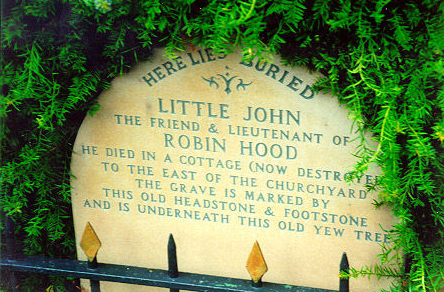
Sherwood Forest, Ollerton, Nottingham and most local to us, Little John's
Grave at Hathersage. It was something that we could both enjoy together, each
on our own level.
AWW:
What's the centuries-long attraction of characters like Robin and Marian?
TT:
For me the attraction is that Robin Hood is the hero of the common folk.
In all my writing I find that the people at the bottom of the pile are the
most interesting. Though Marian has often been depicted as an aristocrat,
I wanted to look at other more earthy possibilities for her. I also wanted
my version of Robin to be more rugged. Michael Praed was lovely, but so clean
and handsome. I based my image of Robert loosely on Bob Geldof - I saw him
as rebellious, scruffy, awkward and moody, but touched by a deep sense of
compassion and a need to fight for justice.
AWW:
What do you think about Marian's traditional role in the modern legend?
TT:
I usually find it boring. As a girl I wanted to identify with Marian, but
the gentle, ladylike image that most books and films gave throughout my
childhood was disappointing. (Rosemary Sutcliffe's Marian was an influential
exception to this.) In recent years I think things have improved. 'Marion'
in the Robin of Sherwood series was more interesting and also in 'Prince
of Thieves,' but the character that interested me most in that film was Fanny,
Little John's wife. I thought, yes... there would be tough peasant women
like her, who'd have gone along with their men when they were outlawed and
lived rough with them, struggling to raise children at the same time. I wanted
to take that idea further.
AWW:
Usually a "strong" Marian seems little different from the other Merry Men.
Your Marian, however, is quite different. How did you come to create her
and her own band of friends?
TT:
First of all I wanted her to be strong in a very female way and not just
an honorary man, that is why she is a healer and a midwife and a very good
food provider. She will fight if she really has to, but doesn't enjoy it
. I didn't want her to be just a token woman, so that is why she needed her
own gang of friends. I looked at Robin Hood's traditional band and used that
as a starting point. Phillipa is rather like Little John, Mother Veronica
and the rebellious nuns are like Friar Tuck, Lady Matilda and Isabel are
like Sir Richard at the Lee, Emma is a little like Much. The sheriff's wife
has always played her part in the story when Robin Hood disguises himself
as a potter and goes to Nottingham, but she isn't usually made into a very
lively character, so I tried to do that in Child of the May.
AWW:
Your characters are excellent role models for young people, particularly
young girls. What do you think is the importance of role models?
TT:
I'm glad that you think they are good role models. As with most writers,
I think my own values come through into the story and that is natural and
bound to happen. What seems to me to be important is that young people read
widely and have the opportunity to consider many different role models and
ways of life, so that they can make up their own minds about what is right
for them.
AWW:
A lot of historical events are mentioned in the Forestwife trilogy, and
in your other books as well. How do you work history into fiction?
TT:
I decided to place my Forestwife stories at the time of Kings Richard and
John, as that seems to be the most popular modern tradition. I thought that
the story idea was different enough without me trying to set it in another
time. I started to study historical events during these two reigns and found
that the real return of Richard from captivity was pretty dramatic. I thought
that the outlaws involvement with Bishop Hugh of Northumberland seemed plausible
and fitted well. (At one time Bishop Hugh's critics accused him of 'harbouring
outlaws'.) I later became very fascinated by the real history of William de
Braose and his wife Matilda, who were persecuted by King John. Again, I felt
that it was a bit of real history that fitted well with my story and interest
in medieval women. In the third book Path of the She-Wolf, it seemed
very natural to extend this interest into the time of Magna Carta. Giles
de Braose was William's brother. He was Bishop of Hereford and one of the
leaders of the Magna Carta rebellion.
Importance of history - Though I have no qualifications as a historian,
I do find that I'm more and more interested by what has happened in the past.
If we understand what has gone before and how people have coped with terrible
hardships, it might help us to deal better with our own lives and problems.
AWW:
You also focus on the role of women in history, something that is often
sadly neglected. Did you have any special challenges in using this aspect
of history?
TT:
Early on in my 'Forestwife' project I almost gave up, when I realized that
the earliest ballads had no Maid Marian in them. However, reading books
on Medieval Women brought me back on track. Women in Medieval Life
by Margaret Wade Labarge was perhaps the most important. She describes
the lives of Medieval women in detail, including nuns, peasants and healers
and she has a whole chapter on 'Women on the fringe' including outlaws.
She claims that women who stepped
out of line were punished more harshly than men, as it was felt to be more
threatening to society if a woman misbehaved. Reading this and other books
on the subject encouraged me to return to the story and do my best to make
it reflect the real lives of medieval women. I do feel that women's history
is rather hidden, but find that when you look closely enough at any time,
you find that the women are there and often their role is very interesting.
At the moment I'm writing another trilogy about how the Amazon women played
a role in the Trojan War. (Title - The Moonriders) This aspect
of the story is rarely focused on, but when I started to investigate I found
that there is a lot of information on the subject, going right back to classical
times.
AWW:
Most of your stories use Yorkshire folklore. As you live in Robin Hood's
Yorkshire, what is the importance of place in the Forestwife trilogy?
TT:
First of all I love writing about places that I know well as I find that
I am never lost for description or detail, and I think the finished effect
is usually more vivid. I also love studying local history. As I've lived
in Sheffield for 28 years I feel pretty loyal to the school of thought that
Robin Hood could have come from Hallamshire [the old name for the area which
contains Sheffield and Loxley]. Where I live we have an old pub just round
the corner that's called The Robin Hood, I have discovered that the previous
building that stood there in the 1600's was called The Robin Hood and Little
John. The road that leads away from it is Archer Rd, and close by Beachief
Abbey has ancient woodland that some historians claim was once linked to Sherwood.
One of the Abbots was the retired Sheriff of Nottinghamshire and Yorkshire.
None of this is proof of a Robin Hood connection, but it all feeds the imagination
and when you are writing fiction, part of the joy of it is that you can put
what you want to be true into your stories. I don't think there should be
too much disagreement as to whether Robin Hood came from Sheffield or Nottingham
as it seems to me that common sense tells you that outlaws might use both
areas and travel about quite a lot. From my studies on Richard the Lionheart
and the way he travelled the country at great speed, I come to the conclusion
that medieval journeys might not have been as difficult as we think, especially
if you wouldn't hesitate to steal horses or might have the sympathy of the
local peasant population!
AWW:
The Forestwife also ties in the mythical elements of the Green Man and a
female counterpart, the Green Lady. Could you please elaborate a bit
on this area of folklore?
TT:
I very much enjoyed the mystical 'Herne the Hunter' aspect of the Robin
of Sherwood series. I'd read theories claiming that Robin Hood stories
were really folk mythology about a nature spirit, the Green Man. I had the
idea that it might work well if both my Marian and Robert had a mystical
side to them, which comes from their belief in the Green Man and the Green
Lady. They use nature, but they respect it too. They kill the deer, not for
fun but for food and then they organize a ritual dance to honour the deer
and give thanks. If anyone would like to know more about this I'd recommend
Robin Hood - Green Lord of the Wildwood, a book by John Matthews.
This suggests that Robin Hood is really a semi-divine embodiment of the life-force
of the land, whose spirit lives on in the stories. Green Man carvings are
still to be seen in many English churches and a few Green Ladies too! I also
believe that at the time when my story is set, ancient pagan beliefs still
ran alongside Christianity fairly peaceably. That's why I have my rebellious
nuns, (who I see as good Christians) working together with those who still
celebrate the turning of the seasons in a more pagan way.
AWW:
Why did you chose to jump forward 15 years for Child of the May, and to
focus on a new character? Marian says that Magda reminds her of her younger
self. What do you think the differences between the characters are?
TT:
My plan was to cover the whole lifespan of Marian and Robert, so time had
to move on. I jumped fifteen years so that Magda (little John's daughter)
would be a new teenage character for young people to identify with, also
that timing fitted well with the story of Matilda de Braouse, which I'd become
very interested in. I think the two characters of Marian and Magda are
similar as they are adopted mother and daughter, but Magda has been brought
up in the woods and wastes with all the skills that she needs in that environment,
whereas Marian was the other way round, she had to learn to survive in the
woods. Magda is more self confident from an early age and more willing to
say what she wants and please herself. Marian develops a strong sense of duty
to those about her and she almost always puts that first.
AWW:
The third book in the series, The Path of the She-Wolf, does not
appear to be available in North America. Are there any plans to release it?
TT:
This is a rather sad problem for me. The USA publishers felt that I had
made the third part of the trilogy more adult than the first two books and,
therefore, didn't take it on. I haven't given up hope that it will eventually
be published in USA, but there are no plans for it at the moment. At the
same time I have a another problem, The Forestwife is now out of print
in UK though I still hope it will be reprinted. I suppose these are the sort
of difficulties that most sequel writers come up against at times and there
seems to be little that I can do to put it right.
AWW:
I think The Forestwife can be enjoyed by all ages. How do you
think writing young adult fiction differs from writing fiction strictly for
adults? Or writing for even younger audiences?
TT:
In a way this relates to the question above. When I am writing for young
adults e.g. The Forestwife, I simply write for myself and this
seems to be as adult as I can get (Perhaps this means that I'm childlike
or maybe young at heart!) However ... perhaps there are times when this method
does overstep the boundary as far as ageing books for the market is concerned,
so that a story sometimes develops a slightly more adult theme. I'm afraid
this is the only way that I know how to be sincere for this age group and
I do believe that teenagers want well written, fast moving stories that do
explore adult themes. I love to have a book for younger children on the go
at the same time. If I get tired of one manuscript, I just flip over to the
other. Writing for younger children is a relief at times, as I feel that anything
magical can happen and the simplicity that's acceptable for the younger age
range is a pleasant change.
AWW:
What kind of response have you had with the Forestwife series?
TT:
I have had a very enthusiastic response from young girls in USA and I do
get quite a lot of letters and emails about the two books that are published
there. There has not been such a good response from the UK. I don't know
why this is. I think it doesn't help that the first book of the trilogy is
out of print at the moment.
AWW:
Is there anything else you would like to add?
TT:
No , I think your questions have covered everything that is important, and
I've been pleased to have an opportunity to do this.
AWW:
Thanks very much for your informative answers.
Interview
(c) Copyright 2001 -- Allen W. Wright
Please visit Theresa Tomlinson's
Official Website.
Please
check out my Robin Hood Spotlight review of The Forestwife.
For
those interested in the ballad about Robin Hood's time as a fisherman, which
Theresa mentioned, check out Robin Hood's
Fishing at the Robin Hood Project at the University of Rochester.
The ballad is preceded by a scholarly introduction by Stephen Knight and
Thomas H. Ohlgren.
NEW!!
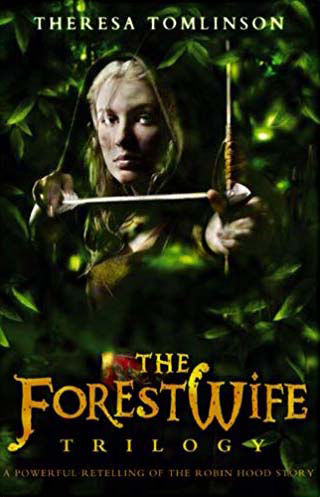
-- THE FORESTWIFE TRILOGY by Theresa Tomlinson. Available in the UK
only, this collects all three Forestwife books (slightly revised) into
one big edition. And hey, my website is mentioned in the afterword. Thanks,
Theresa. Buy
it on Amazon.co.uk
Buy The Forestwife (book 1) on Amazon.com
Buy
The Forestwife on Amazon.co.uk
Buy Child of the May (book 2) on Amazon.com
Buy
Child of the May on Amazon.co.uk
Buy The Path of the She-Wolf (book 3) on Amazon.co.uk
|